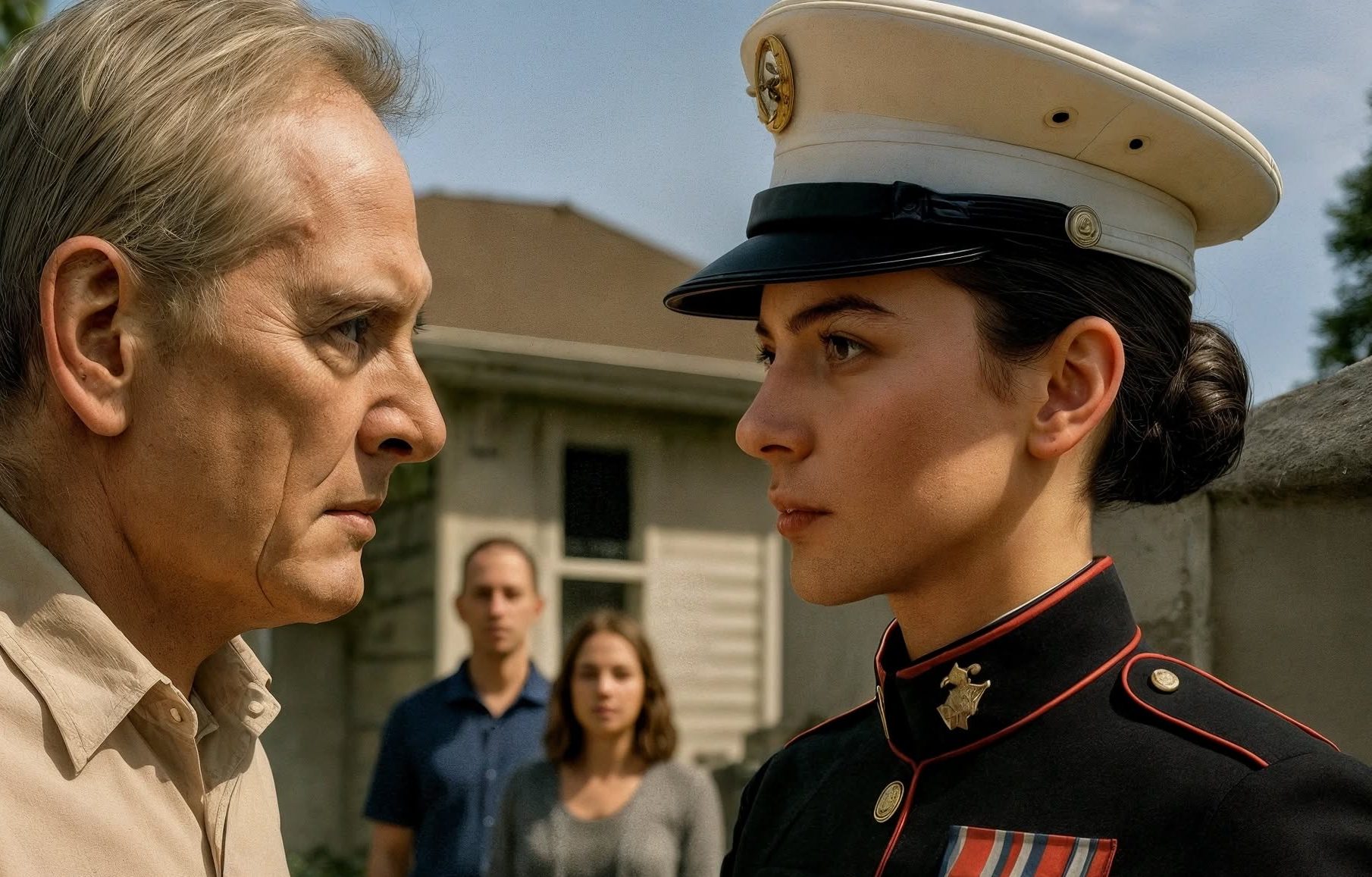
I was nineteen when everything I thought I knew about home collapsed in a single sentence.
My father looked at me with a cold, hollow stare and said,
“Get out. If you chose this path, you can walk it alone.”
Before I understood what was happening, I was standing on the porch with a small bag pressed to my chest. The November air cut through my coat like a knife. My mother’s muffled crying seeped through the windows, but she never came out. My brother leaned casually against the doorframe, arms crossed, wearing a smirk that made the whole moment feel even sharper—almost as if my downfall somehow satisfied him.
Then the door slammed, and the sound echoed longer than it should have.
Just like that, the place I had called home became closed territory.
The cold night carried the smell of damp leaves and distant fireplaces. My coat wouldn’t zip properly, and my hands shook too badly to grip the strap of my bag. I had nowhere to go and no one waiting for me. Only the fragile flutter of the child growing inside me—and a new, quiet promise:
I will not return defeated.
Scrubbing floors and building a life from scraps
I survived by taking whatever work I could get.
Nights: cleaning office buildings.
Days: clearing tables in diners.
My first apartment was a tiny, peeling studio where the sink dripped into a bucket and the radiator rattled more than it heated. I slept under mismatched blankets from a thrift store, curling around my belly to keep the baby warm. Every movement inside me was a reminder: this wasn’t just my fight anymore.
One freezing night, when my borrowed car broke down, I cried on a bus stop bench. A woman in a faded coat sat beside me and placed a hot thermos in my hands.
“Sweetheart,” she said softly, “God never wastes pain.”
I tucked those words deep inside me, like a seed.
I enrolled in night classes at the community college, chasing scholarships, loans, anything that would move me forward. I applied to the Reserve Officer Training Program because structure felt like a ladder—something solid I could climb.
Make a plan. Follow it. Don’t stop.
The day Emily arrived
My daughter, Emily, was born in a small, overbright hospital room. The plastic bracelet still clung to my wrist when I strapped her into a cheap stroller and walked her to the neighbor who watched her during my morning shifts.
Coffee and baby powder scented my days.
Exhaustion scented my nights.
At dawn, the ROTC drills taught me how to march even when my bones were screaming.
Walt, a retired gunnery sergeant who ate breakfast at the diner where I worked, would slide folded scraps of paper toward me: push-up routines, boot-lacing tricks, ways to prevent blisters. He always called me “ma’am,” and somehow that respect took root.
A woman named Ruth brought casseroles without asking questions. A tiny storefront church wedged between a laundromat and a pawn shop became my refuge—the air always thick with old coffee and stubborn hope.
Living on the edge
Money never lasted. When the gas bill arrived stamped in red, I sold my plasma—twice—just to keep the lights on. I made a rotisserie chicken stretch for three meals. Sewed buttons with dental floss. Studied resilience by the flicker of a failing lamp. At the library, I typed my application essay for an officer access program, clicking “submit” with trembling fingers.
The letter that changed my step
The acceptance letter arrived in late spring. I pressed it against my chest and cried—quietly, the kind of crying that turns a dead end into a doorway.
Training tore me apart and rebuilt me.
Maps, azimuths, endurance, discipline.
Hospital corners tight enough to cut the dark.
I missed Emily’s first steps because I was out in the field. I lost a week of childcare over a missed signature and earned it back with apologies and soup for the office staff. My past haunted me at night, but in the mornings, purpose returned like sunrise.
Rank on my collar, Emily in my arms
The day I pinned my first bar, my uniform felt heavy with promise. Emily clapped in a thrift-store blue dress. I sent my mother a photo:
We’re safe. We’re okay.
I didn’t send one to my father.
My pride was still raw.
Climbing toward command
The military became more than a job—it became a bridge. I learned to move people and supplies with precision. Briefed colonels without my voice shaking. The wound of that night remained, but the meaning shifted. My pain had become propulsion.
Years passed. Emily grew into a bright young woman with soft eyes and a talent for leaving kindness wherever she went. I rose through the ranks.
And then came the call.
The December morning that changed everything
My mother’s voice was thin over the phone.
“Your father isn’t well. We’re coming to see you.”
Old feelings gathered like storm clouds.
The next morning, the sky was a pale, brittle blue. Albert—our security officer, who ironed tablecloths as if tucking in children—polished the brass on the door and arranged poinsettias on the steps.
A dark SUV pulled up to the gate.
My mother stepped out first.
Then my brother.
Then my father—smaller than I remembered, his former fire dimmed to embers.
Albert squared his shoulders and asked, in his calm, soldierly way:
“Are you here to see General Morgan?”
They froze.
My father looked up, and recognition—then disbelief—spread across his face.
What happened next
Inside the house, the room filled with people who had helped rebuild my life:
Walt with cookies,
the chaplain who became a friend,
neighbors who believed in small kindnesses.
My father spoke haltingly, with a voice I had never heard from him.
“I was cruel. I thought I was protecting something. I was wrong.”
It wasn’t forgiveness.
Not yet.
But it was a beginning.
We didn’t fix twenty years in one afternoon
Fading wounds don’t vanish on command.
But we ate together.
We told awkward stories.
We laughed at the wrong moments.
Emily moved through the room handing out envelopes labeled,
“Truth first. Kindness right behind.”
When they left, the sky had turned the color of soft roses.
My father whispered, “I don’t deserve this.”
I answered, “We’ll figure it out.”
Justice, as I learned it
Justice isn’t thunder.
It’s systems that protect instead of punish—
food banks, phone trees, small scholarships,
chairs added to tables where honesty is allowed.
Don’t let a slammed door be the final chapter for someone you love.
Show up.
Set the table.
Bring tea.
Twenty years after that porch
When my father finally stood before me again, he didn’t meet the desperate girl he had turned away.
He met General Morgan.
He met the woman I had fought to become.
He met a rebuilt life—
and a daughter who chose mercy without forgetting the truth.
He said, “I was wrong.”
And he meant it.