My husband Daniel had been talking about this gathering for months.
“Just imagine,” he said with the grin he always wore when he reminisced about college, “old friends, good food, and kids running around like we used to.”
He’d been exhausted from work lately, and the spark in his eyes when he planned this made me want everything to go perfectly. So that Saturday morning, we woke up early, put on music, and cleaned every corner of the house together. Emily helped too, following us with her toy broom, copying our moves.
By noon, our living room smelled like freshly baked bread and the lemon cleaner I overused when nervous. Laughter echoed from the patio. Daniel’s college friends — men and women he hadn’t seen in a decade — filled our backyard with stories and inside jokes.
Emily, six years old, normally clung to me at gatherings. But that day she was braver. She followed the other kids around the yard, clutching her stuffed bunny in one hand and trying to keep up with the older kids.
I watched her from the sliding door, proud of her tiny courage.
For the first two hours, everything was effortless.
The grill sizzled.
Old friends clinked beers.
Emily giggled freely.
Then — like a sudden cold breeze — the mood shifted.
I was in the kitchen preparing more lemonade when a loud cry pierced the air. I rushed to the window.
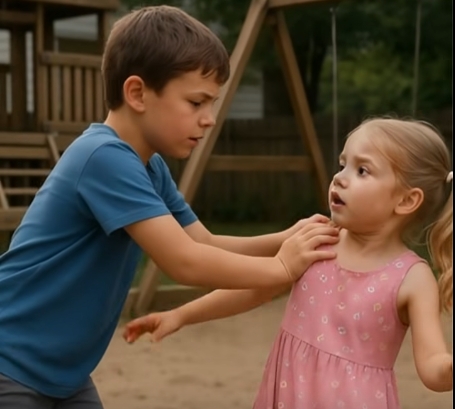
Emily was on the ground.
A boy — bigger, maybe eight — stood over her, hands on his hips. I saw her lip tremble. I saw the grass stains on her knees. My hands turned icy.
I dropped the spoon I was holding and bolted outside.
“Hey!” I called, louder than I meant to. “Stop right there.”
The boy jerked back. His friends exchanged uncertain glances.
“You do not push people like that,” I said, kneeling beside Emily. “Are you okay, sweetheart?”
Her voice was tiny. “He said I couldn’t play because I’m too little.”
I hugged her close.
Behind me, I heard footsteps. Daniel’s.
But something in his expression wasn’t what I expected. He didn’t rush to Emily. He didn’t ask what happened. He just… looked uncomfortable.
A few of his friends stood behind him, watching.
The boy’s father approached slowly, clearing his throat. “Boys roughhouse. It’s normal.”
I rose to my feet, still holding Emily’s hand. “No. Pushing someone smaller is not roughhousing.”
The man scoffed. “You’re making a big deal out of nothing.”
Daniel shifted uneasily. “Let’s… keep things calm, honey.”
That stung. But I swallowed my frustration for Emily’s sake.
The father guided his son back toward the patio, leaving the tension behind like a heavy shadow.
Later that evening, after everyone left and the house was a mess of crumbs and cups, Daniel finally spoke.
“You went too far,” he said, wiping down the counter without looking at me.
I froze mid-step. “Too far? Dan, he knocked Emily down.”
“He’s a kid,” he snapped. “And you embarrassed me in front of people I haven’t seen in ten years.”
The words hit harder than I expected.
“Embarrassed you?” I repeated. “By defending our daughter?”
He rubbed his forehead. “You overreacted. You should apologize. Just to smooth things over.”
I stared at him, stunned.
“No,” I said quietly.
His jaw clenched. “Then maybe…” He hesitated. “Maybe we’re not on the same page anymore.”
The implication hung heavy. Divorce lingered unsaid, but unmistakable.
For a long moment, neither of us spoke.
Then Emily padded into the room wearing bunny-print pajamas, rubbing her eyes.
“Daddy,” she whispered, “do you think I’m too little?”
Daniel froze.
She continued, voice trembling, “That boy said I’m small. And Mommy got upset ’cause she loves me.”
She wrapped her arms around my leg.
Something in Daniel’s face shifted — a crack in the wall of pride and embarrassment he’d been clinging to all evening. His shoulders softened; his eyes flicked from Emily to me and back again.
“Come here,” he said, kneeling.
Emily climbed into his lap. Daniel held her carefully, as though realizing for the first time how fragile she was.
“You’re not too little,” he murmured into her hair. “You’re perfect. Just perfect.”
She sniffled. “Mommy helped me.”
Daniel looked up at me, guilt washing over his features.
“Sarah… I’m sorry.”
I stayed still, unsure if I could trust the sudden change — but Emily leaned toward him, resting her tiny head against his chest, and something in me softened.
He continued quietly, “I shouldn’t have said those things. I was embarrassed, but not because of you. Because I didn’t step in when I should have.”
He swallowed hard.
“You did the right thing. And I didn’t.”
I sat beside them, letting my hand rest on Emily’s back.
Daniel reached out hesitantly, taking my hand.
“I don’t want to lose this,” he said. “Any of it. Any of you.”
For a moment, the chaos of the day faded. It was just us — our little family, imperfect but trying.
Later that night, he wrote a message to his friend, explaining everything and asking for an honest conversation about the kids’ behavior. The friend apologized, genuinely embarrassed by his own reaction earlier.
The next weekend, they visited again — calmer this time — and the boy even mumbled an apology to Emily. She forgave him easily, as children often do.
Daniel became more attentive, more protective, and more open than I’d seen him in years. It was as though almost losing our family forced him to treasure it more.
And though the day had been messy, painful, and full of tension…
It ended with something unexpectedly beautiful:
A husband who learned.
A father who stepped up.
A little girl who felt safe again.
And a family — ours — stronger than before.