
A towering force in Hollywood’s Golden Age, Kirk Douglas left a mark so deep that the industry still feels the echo of his presence. His journey was not one of glamour from the start; it was a life forged through adversity, ambition, and relentless discipline. Born Issur Danielovitch in 1916 in Amsterdam, New York, to impoverished Russian-Jewish immigrants, Douglas grew up in circumstances far removed from the opulence he would one day portray on screen. His family struggled to survive, and as a child, he often worked odd jobs simply to help put food on the table. Those early battles carved into him the grit, hunger, and resilience that would become the backbone of his career.
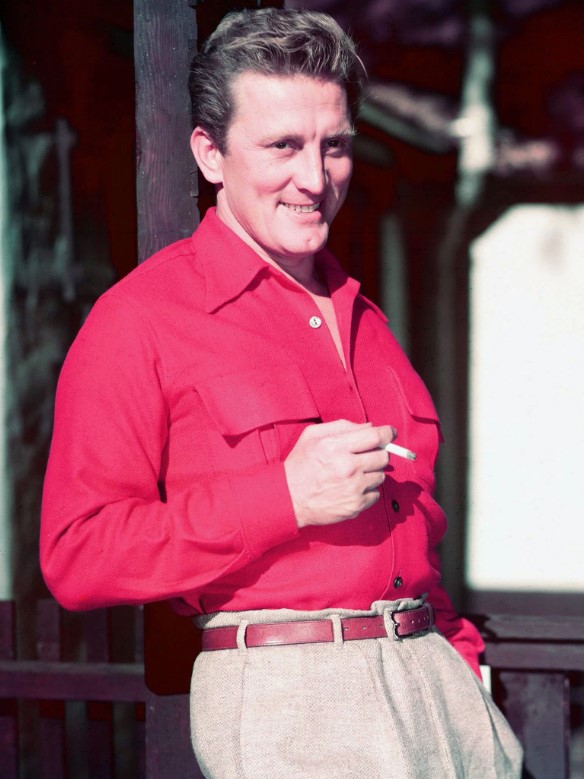
Douglas often spoke of that childhood — the humiliation of poverty, the sting of antisemitism, and the determination that grew inside him as a result. He wanted more than survival. He wanted to break through every barrier placed in front of him. That desire eventually carried him to the American Academy of Dramatic Arts, where he honed not just his talent, but also his uncompromising work ethic. What he lacked in connections or privilege, he made up for with sheer force of will.
By the late 1940s, that willpower had propelled Douglas into the spotlight. With his distinctive cleft chin, fiery eyes, and restless energy, he quickly became one of Hollywood’s most magnetic leading men. He didn’t resemble the typical soft-spoken romantic heroes of his time; instead, he brought a sharp intensity that crackled onscreen. He played men who were wounded, morally conflicted, ambitious to a fault — characters who reflected shades of his own internal battles.
His breakout performance came with “Champion” in 1949, a gritty boxing drama that launched him into the upper ranks of Hollywood stardom. His portrayal of Midge Kelly, a boxer willing to sacrifice everything for success, was fierce and fearless. The Academy Award nomination he received for the role was no surprise. Audiences and critics alike recognized that Douglas brought something rare to the screen: vulnerability fused with raw power.
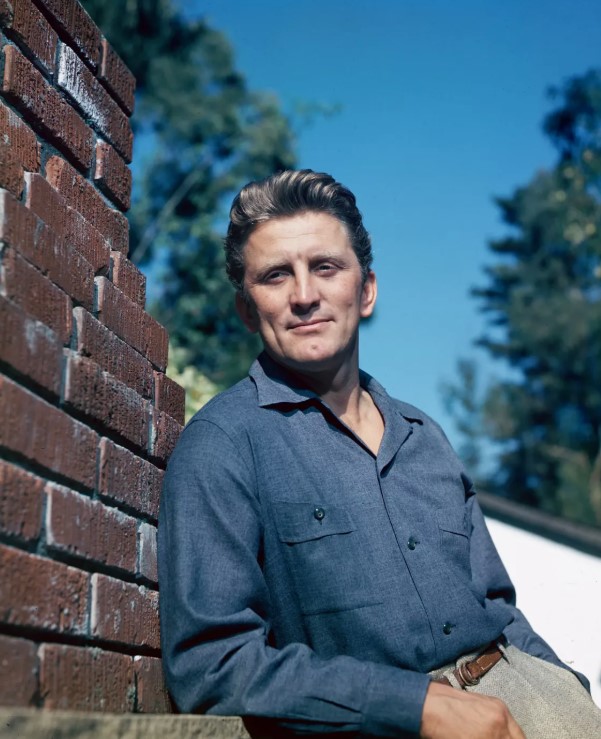
His rise continued through the 1950s, a period that showcased his remarkable versatility. In “The Bad and the Beautiful” (1952), he embodied a manipulative film producer, blending charisma with ruthlessness. “Lust for Life” (1956) revealed another dimension of his talent — an almost haunting immersion into the troubled mind of Vincent van Gogh. For that role, Douglas earned another Oscar nomination and praise for his emotional bravery. Few actors were willing to dive so deeply into anguish, but Douglas approached the role with an honesty that made the character unforgettable.
Then came “Paths of Glory” (1957), directed by a young Stanley Kubrick. Douglas’s performance as Colonel Dax, a military officer fighting for justice in the face of corrupt military leadership, became one of the most powerful anti-war statements in cinema history. It was also a rare example of an actor using his star power not to elevate himself, but to elevate the message of the film. He insisted that Kubrick’s vision remain intact, even when studios pushed for compromises. It was an early example of the moral backbone that would define many of Douglas’s decisions.
That integrity became legendary with the release of “Spartacus” in 1960. Douglas both starred in and produced the film, and during production, he made a decision that altered Hollywood forever: he insisted that blacklisted screenwriter Dalton Trumbo be openly credited. At a time when even acknowledging blacklisted artists could destroy careers, Douglas publicly defied the system. It was a seismic act of courage, one that effectively shattered the Hollywood blacklist and helped restore dignity to countless writers whose careers had been destroyed. Douglas didn’t simply act the part of a rebel gladiator — he lived it.
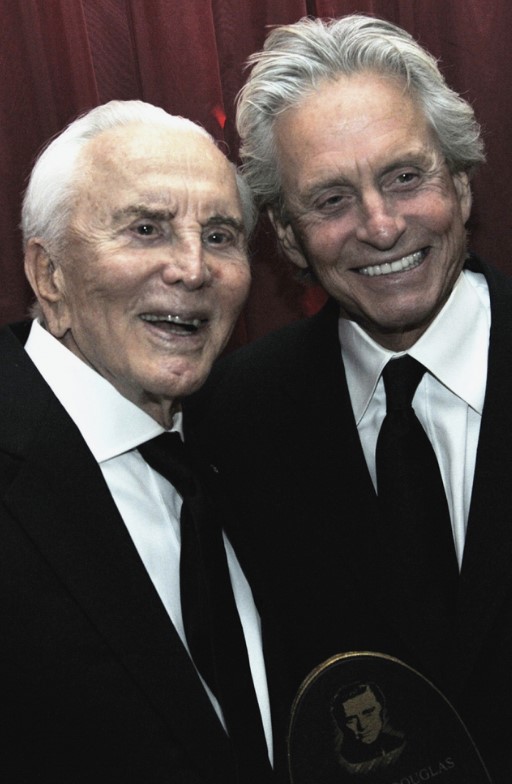
His life off-screen was equally compelling. Douglas survived a catastrophic helicopter crash in 1991 and later a severe stroke that temporarily took his voice. Instead of retreating from public life, he fought his way back through painful therapy and regained his speech. He wrote several autobiographies, using his struggles as examples of resilience rather than defeat. He and his wife Anne donated millions through the Douglas Foundation, supporting education, Alzheimer’s care, hospital renovations, and programs for underprivileged children. He believed that success meant little unless it was used to uplift others.
In his later years, Douglas embraced his role as a patriarch of Hollywood. Younger actors and directors often sought him out, not only for his stories but for his wisdom about the industry — and about life itself. He spoke often about surviving discrimination, navigating fame, and staying grounded through adversity. Even after his stroke, he remained a presence at film events, award ceremonies, and charity functions. Each appearance reaffirmed what people already knew: that Kirk Douglas was not simply a movie star but a cinematic institution.
His legacy stretches far beyond his vast body of work. He was a symbol of perseverance, a reminder that greatness is rarely born from comfort. He proved that a poor boy from a working-class Jewish family could rise to become one of the most honored and respected actors in American history. He demonstrated that courage in the arts can ripple outward, influencing politics, ethics, and the lives of countless people he would never meet.
When Douglas passed away in 2020 at the age of 103, tributes poured in from around the world — from actors who grew up studying him, from filmmakers who admired his daring choices, and from fans who had been moved by his incomparable performances. His impact is still felt today in the careers of artists who embrace risk, challenge injustice, and believe that the truth — no matter how hard — always belongs on the screen.
Kirk Douglas was more than a performer. He was a fighter, a pioneer, a storyteller, and an icon whose courage helped reshape Hollywood. His films remain timeless, but his spirit — fierce, honest, and unyielding — is what continues to inspire generations.