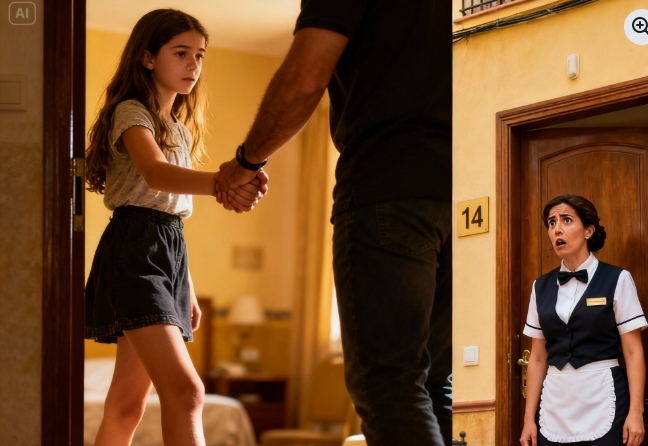
Mariela had been employed at a small roadside hostel called El Faro for five years. This old building, situated along the highway, welcomed truck drivers, traveling families, and lone wanderers who stopped for the night before continuing their journey. During her night shifts, she had witnessed many strange incidents, but nothing that truly unsettled her… until they arrived.
One night in March, a young girl—around fourteen years old—walked into the reception area, following a tall, broad-shouldered man with an unkempt beard. He registered as “Rubén Cifuentes and family.” The girl didn’t say a word; she kept her gaze fixed on the floor, as if she wanted to become invisible. Mariela noticed, but at first didn’t think much of it: the hostel often saw shy or bored teenagers eager to get to their rooms quickly.
But after that night, something felt wrong.
They returned every day at the same time, just after ten in the evening. They never ordered additional services, never came downstairs to the dining room, and most disturbingly, the girl was never alone. Rubén accompanied her even when she went to the vending machine. Mariela tried to smile at her, but the girl only glanced at her briefly—and in that fleeting look, Mariela felt a chill. There was a silent plea for help in her eyes.
One night, when the hostel was almost empty, Mariela went to the second floor to fetch fresh towels. As she passed room 207, she heard a loud thud. She stopped. Then came a man’s voice—sharp, threatening. She couldn’t make out the words, but the tone made her grip the towel tray tighter.
She forced herself to continue working, trying to convince herself it wasn’t her business. But half an hour later, she noticed that the bathroom window of room 207 was slightly open. If she leaned in, she could see part of the interior.
Mariela didn’t want to look. She told herself she shouldn’t. But her instincts said otherwise.
She leaned forward.
What she saw took her breath away.
The girl was sitting on the edge of the bed, silently crying, a dark bruise visible on her shoulder. Rubén was gripping her wrist, speaking to her close to her face in a tone that blended threat with absolute control. Even though Mariela couldn’t see the whole scene, it was clear the girl was terrified.
Mariela recoiled. Her heart pounded violently. She knew something terrible was happening in that room—something she could no longer ignore.
And that night, she made a decision that would change the lives of everyone in El Faro.
A decision no one else dared to make.
Mariela spent the next several minutes pacing around the small office, her hands trembling. She felt a sudden need to act but was paralyzed by fear. What if she was wrong? What if Rubén really was the girl’s father? What if he confronted her?
She knew the police didn’t always respond quickly to “suspicions without evidence.” She had seen complaints go unanswered before… but this was different. She had seen the bruise, seen the terror in the girl’s eyes. It wasn’t her imagination.
She picked up the phone to call, but at the last moment, hesitated. Maybe she should wait a little longer… observe… gather courage… intervene on her own before it was too late. Her chest was filled with a mix of anger and helplessness; witnessing abuse without being able to help made her feel like she was burning from the inside out.
When the clock struck 11:30, she made up her mind to return to the room. She walked confidently down the hallway, though her stomach felt tight. As she passed room 207, she heard footsteps and a metallic noise—like Rubén was securing something besides the main lock. Something in that sound—dry, mechanical, too loud—unnerved her.
She waited for the hallway to fall silent. When it finally did, she leaned again toward the bathroom window. This time the curtain was slightly drawn to the side. Through the gap she saw Rubén sitting, drinking from a bottle, while the girl sat motionless in the corner of the room. She looked as if she wanted to shrink into nothingness. Rubén was muttering something she couldn’t hear, but his expression made the threat clear.
Mariela knew she couldn’t wait any longer.
She rushed to the reception desk and dialed the local police. This time she didn’t hesitate. She explained what she had seen, emphasized her fear for the minor’s safety, and requested immediate assistance. The operator said they would send officers, but they needed to verify first.
While waiting, she couldn’t sit still. She returned to the second floor, pretending to inspect rooms, but truly listening for any sign of trouble.
Then she heard it.
A muffled sob. Something falling. Then a scream that froze her blood.
At that moment, Mariela decided to act—without waiting for help.
She banged on the door of room 207 with all her strength.
“Is everything all right?” she called, trying to keep her voice steady.
Silence. Then heavy footsteps approached. Mariela stepped back slightly, but didn’t turn away. She couldn’t show fear.
The door opened a few centimeters.
Rubén glared at her, annoyed.
“Everything’s fine,” he said curtly. “Please stop disturbing us.”
But Mariela saw behind him the outline of the girl… and worse: a fresh red mark on her cheek.
She couldn’t wait for the police.
She took a deep breath.
She had to intervene—even if it meant putting herself in danger.
What truth lies behind the door of room 207?
Time froze. Mariela knew that if she backed down now, the chance to help the girl would be lost forever. Rubén tried to close the door, but she blocked it with her foot.
“I need to speak with the girl,” she said firmly. “It’s hostel protocol in case of loud disturbances.”
It was a lie—but she prayed he wouldn’t know that.
Rubén glared at her with barely contained rage. For a moment, she feared he might shove or attack her. But finally, he stepped aside slightly.
“Make it quick,” he growled.
Mariela cautiously entered. The room smelled of alcohol and dampness. The curtains were partly torn, the bed a mess. The teenager sat in the corner, hugging her arms as though shielding herself from the whole world. Mariela approached gently.
“Are you okay?” she whispered.
The girl hesitated, glanced nervously at Rubén as if seeking permission—or fearing consequences. Then she shook her head. So subtly it was almost invisible, but enough for Mariela to understand.
That tiny gesture was the spark.
Mariela turned to Rubén.
“The police are on their way,” she said, her voice steady with unexpected resolve.
Rubén’s expression shifted instantly—from shock, to anger, to something else: fear.
“You shouldn’t have done that,” he barked, stepping toward her.
But at that very moment came a loud noise from the staircase. Voices. Quick footsteps rushing upward. Relief washed over Mariela so suddenly she nearly collapsed.
Rubén realized everything.
He tried to run toward the window, but before he made two steps, two officers burst into the room. One pinned him down while the other cuffed him. He hurled insults, accused Mariela of lying, even tried to coerce the girl into defending him. But she didn’t say a word.
She only cried.
When he was taken away, silence fell over the room like fresh air filling a vacuum.
A female officer knelt in front of the girl.
“You’re safe now,” she said softly. “It’s over.”
It took the girl several seconds before she could speak, but she finally whispered her name: Lucía. She wasn’t Rubén’s daughter. He was her stepfather, and they had fled their town after her mother tried to report him for domestic violence. Rubén had taken her without permission, isolating her in cheap hostels, far from anyone who might intervene.
Until Mariela looked through that window.
That same night, child protection services arrived at the hostel. Lucía was taken to a safe shelter, and thanks to Mariela’s testimony and other evidence, Rubén was arrested and awaited trial.
A few days later, Mariela received a letter written in a trembling hand.
“Thank you for not looking away.”
She tucked it into the pocket of her work apron, knowing that while working in a hostel often revealed life’s darkest sides, it also gave her the chance to bring light where it was needed most.
And that light saved a life.