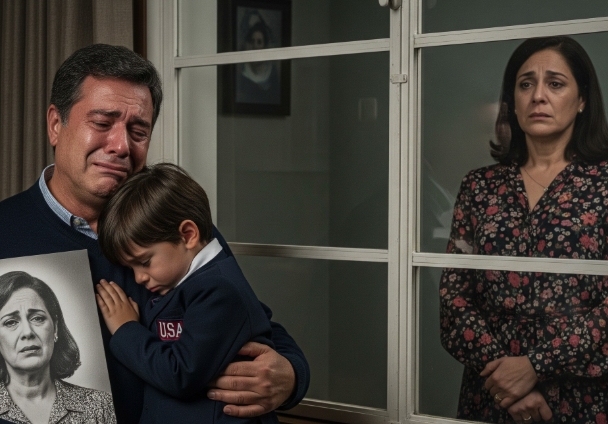
My wife died two years ago. Since that moment, every day of my life has revolved around Lucas—around making sure he felt safe, even when I was falling apart inside. But yesterday he said something that sent a chill straight through me. He claimed he had seen his mother. And even more unsettling: according to him, she had warned him not to follow her.
When he spoke those words, his voice sounded different than usual—quiet, almost trembling, as if he was afraid of what he had witnessed. At first, I assumed it must have been a nightmare. Eight-year-olds often blend imagination with memories and reality. But the look on his face made it impossible to dismiss what he said as a child’s fantasy.
“Dad… Mom was standing on the school playground. She called me. And she told me not to come after her.”
That one sentence echoed in my mind all night long—too clear, too specific to be a random dream.
I tossed and turned, thinking of Clara—her laugh, the way she said my name, the final phone call she made on the day she died. I tried to push Lucas’s words aside, but I couldn’t.
The next morning, I walked him to school as usual, but right away I noticed he wasn’t himself. He didn’t look around, didn’t smile. He walked silently, as though carrying a weight he couldn’t describe.
I decided to pick him up earlier than usual. Something inside me—something I couldn’t logically explain—was warning me that something was wrong.
When I arrived at the school, a wave of panic rose in my chest. I heard shouting from the playground and saw a group of children gathered near the side fence. Lucas wasn’t among them.
“Where is my son?!” I almost shouted at one of the teachers.
A girl quietly said she had seen Lucas walk away with a woman in a light-colored coat.
The words froze me.
I ran toward the side gate. As I rounded the corner, I saw the very thing I had been afraid of.
Just a few meters ahead, a woman was holding Lucas’s hand. A slender figure, long brown hair, and the exact same color coat Clara wore nearly every day. It felt like my heart stopped.
Before I could think, I sprinted, shouting his name.
The woman turned her head. And everything inside me spun.
It wasn’t Clara.
Yet her face… her face was so similar it was like looking at Clara’s reflection.
As soon as she saw me, she let go of Lucas’s hand and disappeared into the crowd. I had no chance of catching her.
Lucas was trembling.
“Tell me who she was,” I whispered, kneeling beside him.
He wiped his eyes.
“She looked like Mom… but she wasn’t Mom.”
I called the police immediately, reporting it as an attempted abduction. Officers searched the nearby streets, but the woman was gone.
That evening, I went through Clara’s old things. Among photos and documents, I found something I had never noticed before—an email dated two weeks before her accident, sent from an unfamiliar address.
The subject line: “We need to talk about Lucas.”
The message was short, disturbing:
Clara, you can’t keep this a secret. If something happens, he has the right to know the truth.
The next day I brought the email to the police. Detective Ramiro Ortega took over. After a few days, he discovered the sender: a woman named Sofía Gómez, who once worked at a fertility clinic in Seville.
When Ortega called me again, his voice was tense:
“We’ve located Sofía. She wants to speak with you.”
I met her in a quiet café. When she walked in, I froze. It was the woman from the street—the one holding Lucas’s hand. The same face. The same eyes.
“I’m sorry,” she said as she sat down. “I never wanted to harm your son. I just… I needed to see him.”
“Tell me who you are.”
She took a shaky breath.
“Clara was my twin sister. We were separated at birth. She never knew about me… I found her only when her health started to decline.”
I felt the world tilt beneath me.
She told me about the adoption, the years of searching, meeting Clara shortly before her diagnosis, their conversations, their letters—and that Clara made her promise one thing:
Do not interfere in Lucas’s life if I’m gone.
Sofía had only one sentence she was supposed to repeat if Lucas ever saw her:
“Don’t follow me.”
Not to frighten him.
But to say goodbye for her.
The police closed the case. It wasn’t kidnapping. It was grief, loss, and a woman who found a sister only to lose her too soon.
Lucas had nightmares for weeks. Therapy helped him slowly regain confidence.
Months later, I received a letter from Sofía.
“I will never try to replace Clara. But I can help protect her memory—if you’ll let me.”
I invited her to dinner. Lucas studied her for a long moment… then walked up to her and hugged her, gently and without fear.
Not as a son greeting a mother.
Not as a child greeting a stranger.
But as someone recognizing a missing piece of his life.
Today Sofía is part of our lives—not as a shadow of the past, but as someone who carries a fragment of Clara within her.
And when Lucas asks about his mother, I tell him:
“She’s with us. In your heart. And in the way we still know how to love, even when it hurts.”