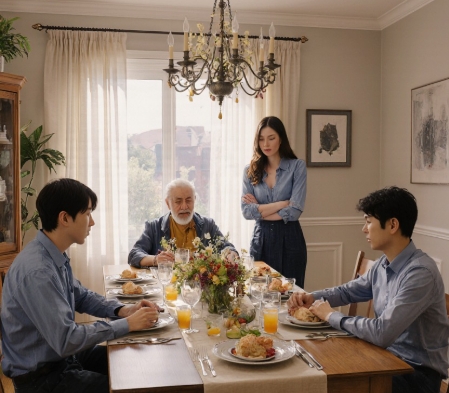
“Why on earth do you need a car, Lena?”
Valentina Petrovna stared at me as if I had announced I planned to take out a loan by pawning my kidneys.
I was just chopping a salad.
It should have been a pleasant moment: Friday, end of the week, paycheck in my account, kids at home, chicken cooking in the oven. And suddenly — she looked unsettled for no reason.
“What’s wrong with it?” I answered calmly, though inside everything was already boiling like overcooked potatoes. “I got a bonus, I have a driver’s license, and commuting is a survival challenge — two hours and transfers. And honestly, I just want a car. I can afford it.”
She snorted, folding her hands on her hips. Dressed in her worn-out kitchen robe, she wore an expression of pure tragedy.
“‘I want,’” she mimicked. “Such a powerful argument! A car isn’t perfume or pantyhose — it’s expenses, maintenance, fuel, parking, insurance! In our family, men always drove. And who are you supposed to be? A chauffeur now?”
I didn’t reply — I already knew we were about to spiral into another pointless, well-trodden argument.
A chair scraped in the kitchen — Igor got up after finishing his slice of bread. My husband. Almost fifty, but still glued to his mommy like a schoolboy. His head apparently starts hurting anytime I make a decision without consulting “the family council,” which, in reality, consists of him and Valentina Petrovna.
“Mom, calm down,” he muttered, not even glancing at me. “Len, maybe you don’t need a car? What will you do with it alone?”
“Alone?” I turned to him, holding the knife — just holding, not threatening.
“Am I not a person? I carry heavy bags from the market, I shake in crowded minibuses like a sardine in a can, and that’s after three transfers. Now I get a bonus — twenty years of work — and finally want something for myself. Don’t I have the right?”
“No one’s arguing,” he shrugged. “Just… think it over. You’re not that young. A car isn’t just ‘I have a license,’ it’s a responsibility.”
“Oh, and you are what — responsibility in slippers?” slipped out of me.
“Have you ever driven me to work? Ever picked me up at night?”
He stayed silent.
And not out of guilt — but because his mother sat down next to him, took a theatrical sip of tea, and slammed the cup onto the saucer.
“Lenochka, don’t get angry,” she cooed. “We only want the best for you. It’s just… seeing a woman behind the wheel is always awkward. Especially at your age. Fine, buy your little ‘bubble car.’ And then what? Drive around courtyards when you retire?”
That was it.
I wiped my hands on the apron, took it off, and hung it up. Put the knife away.
“You know what, Valentina Petrovna,” I said, trying to keep my voice steady, though it trembled with restrained frustration.
“You’ve lived in our home for a long time. You use everything — from the remote to the fridge. In my house. And yet you feel entitled to dictate what I can or cannot do.”
“This is Igor’s house!” she shrieked. “He bought it before you married!”
“Correct,” I nodded.
“But we pay the mortgage together. I did the renovations. I wash your dishes. So tell me — who exactly are you here? A life expert?”
“Mom!” Igor jumped in. “Why are you starting? Lena, you can’t talk like that!”
“And how should I talk?” I locked eyes with him.
“Have you ever supported me? In anything?”
Right then, Masha — our nineteen-year-old daughter — walked in. University student. And that look I knew too well — oh great, here we go again.
“Mom, what’s going on?”
“Grandma is against the car,” I answered. “Says women behind the wheel are a joke.”
Masha rolled her eyes.
“Oh my God, this again. Mom, do you want the car?”
“I do.”
“Then that’s it. Buy it. It’s your bonus and your life. Kirill and I support you.”
“And who are you two to decide?!” Valentina Petrovna screeched.
“Children! A student and a brat! I make decisions in this family! Oh… I mean — we! Igor and I!”
At that moment, a door slammed.
Kirill, sixteen, stepped out wearing headphones.
“Grandma, don’t stress. Mom, if you buy it, I can help you practice parking in the evenings. It’ll be fine. Just buy it.”
“Thank you, son,” I said — and for the first time in ages, I smiled genuinely.
Igor stayed silent. As always.
That evening, when everyone dispersed, even Valentina Petrovna fell asleep to the TV, I sat at the kitchen table, thinking. An empty mug in front of me, darkness behind the window, and a roaring storm inside my head.
I felt cornered — still “the accountant’s wife,” “Masha and Kirill’s mom,” “Valentina Petrovna’s daughter-in-law.”
And where was I?
Just me. Lena. Nearly fifty. A woman who never had a quiet moment, always doing everything for everyone else.
But this time, I didn’t want “must.”
I wanted “want.”
And I realized: it was time to change something.
In the morning, I went to the dealership.
Without the “family council.”
The moment everything changed:
I placed the car keys right in the center of the dining table. Loudly. So they clinked and made themselves known.
“Well,” I said, taking off my sneakers, “congratulate me. I’m officially on wheels now.”
Silence filled the hallway.
The smell of something oily drifted from the kitchen — the unmistakable scent of Valentina Petrovna’s signature “sauce with fried onions.”
Masha discovered me first.
In pajamas, phone in hand.
“You bought it?” Her eyes lit up.
“Mom, you’re amazing! Which one?”
“Lada Granta. Brand-new. Silver. Basic package but with AC.”
“Awesome!” She clapped.
“You’re a queen. Does Dad know?”
I nodded toward the living room.
There sat Igor — in his old Adidas T-shirt and sweatpants, remote in hand, expression like I had just ruined his career.
“Hi,” I said flatly.
“You serious?” he asked, not looking at me.
“Without me? Without discussing it?”
“When did you ever discuss things with me, Igor? Unless it was about how much sour cream to put in borscht. Or when your mother is moving in — again — though she’s lived here three years straight.”
He turned off the TV and stood up — slowly.
“Yelena,” he said in a patronizing tone, “have you lost your mind?”
At that moment, I realized: this conversation had no second chance.
“No, Igor. For the first time — I’ve come to my senses.”
A stool creaked in the kitchen.
She appeared.
Valentina Petrovna in her beloved leopard-print robe, hair clip sticking up like an old TV antenna.
“You bought a car?” Her voice sounded like an ice-cold shower.
“With what money?”
“With my bonus,” I replied calmly. “Shall I show the paperwork?”
“Show a psychiatrist’s note while you’re at it!” she howled.
“A woman your age! With two kids! Buying a car! And a LADA at that! They’re for taxi drivers and losers!”
“Well then I’m a taxi-driving loser,” I smirked.
“And you, Valentina Petrovna, are a passenger without a say.”
“Don’t you dare talk to me like that!” she shouted, approaching.
“I raised you! I gave you Igor! Thanks to me you’re in this family!”
“Oh bless you, saintly mother,” I laughed.
“You didn’t give birth to me, did you? Don’t take too much credit.”
And suddenly — she shoved me.
Hard.
In the shoulder.
I stumbled into the wall.
“Don’t scream at my mother!” Igor yelled, grabbing my arm.
“Are you insane?”
“She pushed me!” I jerked my arm away.
“You’re insane if you think I’ll keep tolerating this! Constant yelling, judgment, every move I make under a microscope! Have you ever stood up and told her: ‘Mom, stop’? Ever?”
“You provoke her!” he shouted.
“A normal wife would have consulted her family first!”
“I’ve been consulting for twenty years!” I screamed back.
“And what came of it? ‘Too early,’ ‘too late,’ ‘you cook wrong,’ ‘you live wrong’! I don’t want this anymore! I want to drive. I want silence. I want noise. I want MY life.
My bonus.
My damn LADA!”
Masha stood frozen in the hallway.
Kirill ran out and placed himself between us.
“Don’t touch Mom!” he said loudly.
“Dad, seriously? You never help her. Grandma only yells. Mom — let’s leave. Right now. I’m with you.”
That did it.
The illusion of “family” collapsed.
There was no family — just me and the kids.
“Let’s go,” I said.
“Pack your things. We’re leaving. Now.”
“Where?!” Valentina Petrovna shrieked.
“You’re destroying the home! Taking the children?!”
“I’m leaving. Alone. The kids choose for themselves.
Apparently, they don’t feel comfortable here either.”
“Lena, you’re crazy!” Igor said — but softer, already defeated.
“Yes,” I nodded.
“And it feels great. They say freedom is in your head — I guess mine’s going into the glove compartment. Right next to the phone charger.”
We spent the night at a friend’s place — on the floor, eating frozen dumplings and drinking tea from glass cups.
But I was happy.
“Mom,” Masha said, “I’m proud of you. I thought you’d never do it.”
“I thought so too,” I whispered.
“But then I realized — if not now, then never.”
“What now?” Kirill asked.
“Divorce?”
I nodded.
For the first time — calmly, without tears, without fear.
The next morning Igor called.
“You’re seriously filing for divorce?”
His voice sounded as if I’d declared war.
I sat at a rented apartment, reviewing documents from my lawyer.
“Yes,” I said firmly.
“No ‘maybe,’ no ‘I’ll think about it.’ It’s final.”
He stared as if seeing a ghost.
“But why? You promised…”
“Promised?” I interrupted.
“Promised what — to endure endless insults and humiliation? To live with your mother who believes she’s the queen of the universe and I’m always wrong? Did I promise that? No, Igor.”
He lowered his eyes.
“I don’t know how to live without you and the kids,” he whispered.
“Mom is upset too.”
“Your mother,” I repeated deliberately, “is always upset at those closest to her. If you had ever stood by me instead of her, we wouldn’t be here.”
“I tried,” he muttered. “But she’s always smarter.”
“No, Igor — you just never tried hard enough,” I said, pointing at the papers.
“This is the divorce. Signed. As of today — I’m free.”
Court felt slow, as if time thickened.
Valentina Petrovna sat dressed in her best coat, like she was going to a ball. Her face indifferent, but hatred shone in her eyes.
“Yelena,” she began when allowed to speak, “have you thought about the children? How can you destroy a family so easily?”
“I think about my children every second,” I replied.
“And that’s why I’m doing this — so they won’t grow up in a home filled with lies, screaming, and fear.”
The judge listened, but the real decision was made long before — with every choice we’d made.
After court, the kids hugged me, and I opened the door to our new apartment — small, but ours. Where no one intruded.
But the game wasn’t over.
The next day, Valentina Petrovna showed up uninvited, holding a folder.
“If you want to keep anything,” she said from the doorway, “forget the apartment and the car. Half of it is my inheritance. You signed joint-property documents.”
I exhaled.
“I checked everything. It’s all in my name. This is my property. And from now on — you no longer interfere in my life.”
She looked at me with desperate hope.
“Think, Lena. You can’t manage without us.”
“Can’t?” I smiled coldly.
“No — you can’t manage without me.
Now goodbye.”
A week later Igor called.
“Yelena,” he said quietly. “I couldn’t stay… Mom insisted. But I want you to know — I’m with you. Not as a husband. As a father. I’ll take the kids on weekends… And if you want, I can help with repairs.”
I hesitated — then said:
“Thank you, Igor. It means a lot.”
Three months passed.
I drive my Lada around the city, breathing freedom with every turn of the wheel.
The kids grow up in peace — in our home, not hers.
Igor sees them, speaks softly and tiredly.
And I no longer expect miracles from anyone.
Because now I know:
A miracle is when you take your life into your own hands and finally change it.
The end.