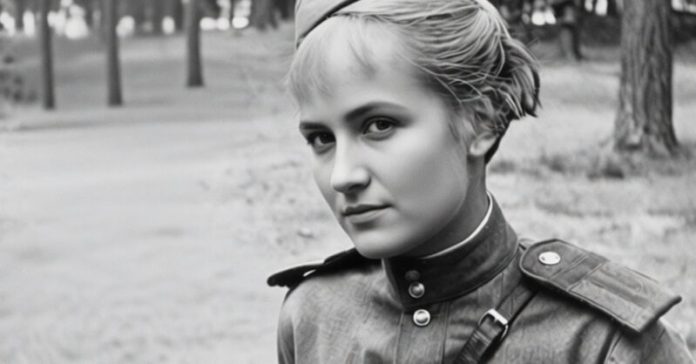
In 1944, the walls of the military hospital—steeped in the smell of medicine and suffering—became silent witnesses to the terror of a young girl’s fate. Margarita, standing before a stern woman in a white coat, felt her last hope dim with every second of heavy silence.
“You’re with child,” the doctor pronounced coldly, almost accusingly.
“How is that possible?” the girl exhaled, though deep inside she already knew the truth and had merely hoped for a mistake.
“Are you asking me?” the doctor replied with a smirk, handing her a certificate that felt more like a bitter verdict.
“Thank you… I’ll go,” Margarita whispered, pulling her worn greatcoat from the hook. She had no desire to explain anything. The fact was undeniable—there would be a child, fatherless, unsupported, conceived in the dead center of war.
She had just turned eighteen when tragedy swept over her life like a firestorm. An orphan raised in a children’s home—where only the strong survived—she learned early the price of breathing. After graduation she worked at a factory, and when the army came recruiting, she was the first to sign up. Her precision and iron will determined her path as a sniper, and by November 1941 she was already standing at the gates of Moscow.
Three years at the front taught her not only to track the enemy but also to survive among her own. Women were few, and at night she often woke from heavy breathing beside her and hands that knew no restraint. But she refused to be anyone’s solace.
In early 1944, Commander Viktor Nikolaevich approached her on the forest edge where she was cleaning her rifle.
“No matter how strict the rules are, they keep going after the women,” he said. “Yesterday Lida was in tears, before that Glasha complained. I can see you’re struggling too.”
“Like wild beasts,” Margarita grumbled. “By day they’re heroes, and by night, after one shot of vodka, they turn into someone else entirely.”
Viktor made an offer:
“If you want, I can spare you from their attention. I’ll tell them you’re mine.”
Thus began a strange and complicated relationship between them that lasted almost six months. Sometimes, embarrassed, she returned to her dugout under the watchful stares of her comrades—but they left her alone afterward.
One day Lida sighed with envy:
“Better if the commander had chosen me—at least he’s handsome.”
“Don’t envy,” Margarita replied with a bitter smile. “He has a wife and three children waiting at home. This war is temporary madness. It will end, and we’ll go back to our real lives.”
“We didn’t lose anything anyway,” Lida murmured. “Here everyone lives one day at a time, never knowing which minute will be their last.”
In October her fears materialized—she learned she was pregnant. Horror seized her heart. The child was hers alone, and Viktor did not need it. When war ended, she would simply become a ghost in his past.
After obtaining the certificate, she returned to the unit and ran into the commander.
“How are you, Orlova?”
“Fine.”
“So why did you faint?”
She handed him the document. His face drained of color as if he’d seen a death sentence.
“What will happen now?” he asked quietly.
“I don’t know.”
“I’ll fix it,” he said at last. “In the end… I’m the father.”
She didn’t understand what could possibly be “fixed.” The child existed—that was the immovable truth. And yet, somewhere deep within her, a fragile hope remained.
In 1945, when victory was approaching, Viktor Nikolaevich called her in.
“You have to go home now, by order.”
“I can stay! I feel fine!”
“I can’t take responsibility for you,” he said. And she understood—this was a trap of fate. When she boarded the departing truck, he whispered:
“Goodbye.”
She couldn’t hold back her tears, realizing he had already forgotten her.
Her room at the factory dormitory was empty and cold. Dust on the windowsill, a wilted flower—everything reminded her of how much she had lost.
Determined to rebuild her life, Margarita returned to factory work. But fate had more trials in store.
Her daughter, Veronica, brought pure joy into her life—but that joy was soon broken.
On the third day after giving birth, while she was nursing little Veronica, officials entered the ward and arrested her for “connection with a traitor.”
“Viktor is no traitor!” she screamed in horror.
But the major avoided her gaze. He only said that the state would take care of the child.
During the interrogations she learned that Viktor had been declared a spy. The court was merciless—five years in the camps.
In 1950, when Margarita walked out of the labor camp gates, she breathed the air of freedom with trembling hope. Her only goal was to find her daughter.
Two weeks later she reached her hometown and met with the director of the children’s home. Her hopes collapsed when she learned that Veronica had been adopted.
“If the mother ever returns,” the director said, “here is the address of the adoptive family.”
Margarita hurried to Kursk, torn between fear and joy.
At the house she met Svetlana Petrovna, the kind woman who had adopted Veronica. Svetlana revealed something Margarita never expected to hear:
“Viktor never broke ties with me. He asked me to look for you… He wanted to make sure you and the child were safe.”
Between the two women a warm friendship blossomed. Svetlana invited Margarita to stay with her and help raise Veronica.
Day after day, watching her little girl grow, Margarita felt her soul slowly healing. Though life had taken so much from her, it had returned something far greater—love, family, and a new beginning.
Each evening, watching her daughter play, Margarita realized that despite all the trials, she and Veronica had finally earned their happiness.
Conclusion:
War took much from Margarita, but in the end she found her way to happiness—reuniting with her daughter and building a new family full of love, warmth, and hope.