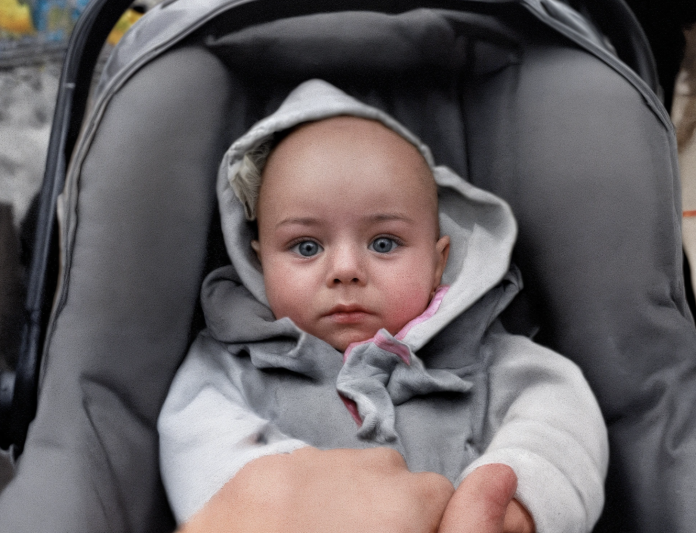
When I turned sixty-eight, my world suddenly shrank to a tiny universe where only two hearts existed — mine and my granddaughter’s.
Six months ago, a terrible accident took my son and his wife.
They had stepped out that morning for a short errand — and never returned.
Just a few days later, fate placed their newborn daughter, Grace, into my arms.
I thought I had already completed the long journey of motherhood and earned a quiet old age — books, knitting, evenings in the garden.
But instead, I once again became someone who stays awake through the night, rocking a baby to sleep.
Sometimes, after Grace finally drifted off, I would sit at the kitchen table, stroking her tiny socks and asking myself:
“Can I really do this? Do I have enough strength? Enough time?”
There were no answers — only the hum of the refrigerator and the soft ticking of the clock.
To make ends meet, I accepted any odd job I could find:
I looked after neighbors’ pets, mended clothes for church fairs, and sometimes read books to children at the local library.
But no matter how hard I worked, money slipped away faster than it came — into formula, diapers, porridge, baby wipes.
More than once, I skipped dinner so Grace could have everything she needed.
Sometimes my entire meal consisted of a couple of potatoes — and I convinced myself it was enough.
But when she smiled and wrapped her warm little arms around my neck, all doubt disappeared.
She had only me left, and I would not fail her.
By seven months Grace had grown into a curious, giggly little person who filled my home with light.
Still, life with an infant meant constant expenses, endless worries, and restless nights.
At the end of that month, I had only fifty dollars left.
I dressed Grace in a warm onesie, tucked her into the stroller, and headed to the supermarket, breathing in the crisp autumn air that hinted at the coming winter.
“Only the essentials, sweetheart,” I whispered as I pushed the cart.
“Diapers, formula, a bit of fruit for your puree. Then home for your bottle — all right, my darling?”
She let out a soft giggle, as if agreeing.
I placed each item into the cart gently, as though handling something fragile.
Every purchase was carefully calculated.
A can of formula. Diapers. I picked up wipes but put them back. Bread, milk, a little cereal, two apples.
I paused at the coffee aisle, held a bag in my hand, then set it down.
“Helen, coffee is a luxury. And luxuries don’t fit into our budget,” I told myself.
At the fish counter, I caught myself smiling, remembering my husband and his famous salmon with lemon and coconut milk.
I whispered:
“He would have adored you, Grace. And you’d laugh listening to his stories.”
At the register, the young cashier, her fatigue barely hidden, rang up my groceries while I rocked Grace in my arms.
“That’ll be seventy-four thirty-two,” she said.
Something inside me sank.
I pulled out my only fifty-dollar bill and began searching my pockets for coins.
Grace started fussing — first softly, then louder and louder, her cries echoing off the high ceiling, growing sharper with every breath I took.
Behind me came an annoyed sigh:
“Are we going to stand here all day?”
Another voice added:
“If she can’t afford it, she shouldn’t be filling her cart!”
Shame made my fingers tremble.
“Please… just the baby items,” I whispered to the cashier. “Remove the rest.”
She rolled her eyes.
“You should check prices before you dump everything in your cart.”
Her words cut deeper than a shout.
Grace cried harder, her wails piercing my heart.
“Oh, someone take that baby out already!” a man snapped.
“She shouldn’t even have a kid if she can’t pay for groceries,” hissed a woman behind me.
Tears stung my eyes.
My hands shook so badly that coins slipped from my fingers and scattered across the floor.
“Please…” I breathed. “Just the essentials…”
And suddenly — complete silence.
Grace stopped crying.
Her tiny body relaxed, and I noticed her little hand stretching forward — not toward me, but toward someone behind us.
I turned slowly.
The entire line froze.
The cashier paled.
People around us fell silent.
Behind me stood a tall, broad-shouldered man in his early thirties, with kind, steady eyes. His expression softened even more when he looked at Grace.
He stepped forward.
“Ring up everything she picked,” he said firmly. “I’m paying.”
The cashier blinked.
“But sir… that’s—”
“I said everything,” he repeated.
I tried to stop him, extending my crumpled bill.
“No, you mustn’t… I just miscalculated… I—”
“Keep your money,” he said quietly. “She needs you. And you’ll need every dollar.”
Grace reached toward him again.
He smiled at her.
“She’s a beautiful child,” he said softly. “And you’re doing an amazing job.”
Something inside me melted.
I nearly broke into tears.
Outside, the man — his name was Michael — helped me carry the bags.
“I have a daughter too,” he said while we walked. “She’s two. I’m raising her alone. Lost my wife last winter. I recognize that look.”
“What look?” I asked gently.
“The look of someone trying to hold everything together… while feeling like everything is falling apart inside.”
For the first time in a very long while, I felt — someone understood.