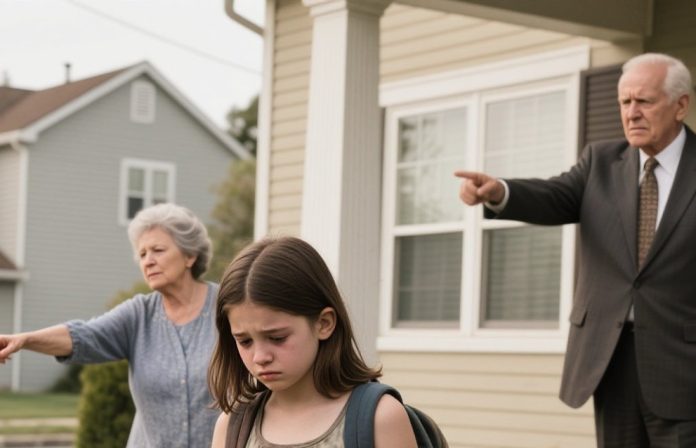
I stood in the middle of our living room, staring at the floor, my small hands trembling as they clutched the hem of my T-shirt.
“Do you have anything to say for yourself, Sofia?”
My father, Luis, thundered across the room.
My throat closed. I couldn’t speak.
“Shameless girl…” my mother, Isabella, hissed.
“Pregnant at your age. How could I have given birth to something like you?”
I tried to say something—anything—but before a word left my lips, my father slammed his palm on the table.
“You disgraced our home! Do you know what people will say? Get out!”
“Please… Mom…”
But her eyes were colder than the rain outside.
“Out.”
They pushed me into the storm and slammed the door behind me.
Neighbors stood at their gates, whispering like spectators at a cruel show. I ran blindly through the rain, crying, begging the sky for help.
That night, I knocked on door after door, but every one of them closed in my face. Even in the park, when I tried to hide under a roof, someone shooed me away. Later, three teenage boys cornered me with awful intentions, and I barely escaped into a narrow alley.
By dawn I was curled under a soaked tree, shivering uncontrollably. It felt like the whole world had abandoned me.
And then I heard a voice.
“Child… what are you doing out here?”
A warm, trembling voice.
It belonged to Margaret — the woman who owned the small neighborhood bakery. She lifted me into her arms, took me into the warm smell of bread and cinnamon, fed me, wrapped me in a blanket, and let me sleep on a wooden bench.
That was the beginning of my new life.
The first weeks were hard. I helped Margaret in the bakery, but customers stared at me with suspicion. One day, a local merchant named Estabon walked in and scoffed:
“Why do you keep this girl, Margaret? She’s a disgrace. Thrown out of her own home!”
Margaret shut him down, but people talked. Soon, fewer customers came.
A street bully, Carlos, pushed me one afternoon, telling me I was the reason the whole neighborhood was “ashamed.” Margaret chased him away, but the hostility didn’t stop.
Eventually the losses forced Margaret to close the bakery for a few days. Guilt ate me alive.
One evening, Carlos and his friends broke in and trashed the place. I couldn’t stop them. When Margaret returned, she found the chaos — and me, crying on the floor.
“Grandma… I have to leave,” I sobbed.
“This is all because of me.”
“No,” she said firmly, pulling me into her arms.
“You are my family. I won’t let you go.”
But I couldn’t bear it.
Before sunrise, I slipped away, leaving a note:
“Thank you for everything, Grandma Margaret. I’m sorry.”
I moved into a cheap boarding house on the outskirts. No one liked me there either. The owner accused me of stealing money — I hadn’t. When I returned one day, my room had been robbed, and they blamed me for that too.
So once again, I was out on the street — hungry, soaked, and clutching my stomach as the baby kicked.
People laughed at my swollen belly. Someone threw a stone. Someone called me a thief.
I crawled into an alley between abandoned buildings and hid my face in my hands.
“Anna… my little Anna… forgive me…” I whispered, stroking my stomach.
And then — light.
A flashlight.
“Sofia!”
Margaret rushed toward me, trembling. She had been searching for me all night.
“Child… why did you leave? You are my family!”
I collapsed into her arms, sobbing. She held me like a real grandmother.
Years passed.
With Margaret’s help, I grew up. I survived a difficult labor. I raised my daughter, Anna — now a smart, confident thirteen-year-old.
I opened a small café in Miami and named it “Anna.”
It became our haven — warm, cozy, filled with the smell of fresh bread that always reminded me of Margaret.
One day, a woman with gray hair walked in.
I froze.
It was Isabella.
“Sofia… forgive me…” she whispered.
Her voice cut like a blade.
Thirteen years later?
After everything?
“You threw me out. You left me to die in the rain. And now… why are you here?”
She trembled.
“Your father… he passed away. He regretted what he did until the end.
And I—I want to fix at least something.”
I turned away, fighting tears.
Anna tugged at my sleeve.
“Mom… is she really my grandmother?”
It was the hardest conversation of my life.
Later that day, Margaret arrived — the woman who truly raised me.
She said quietly:
“Sometimes forgiveness is needed not for the one who was wrong… but for the one who was hurt.
Forgiveness is freedom, Sofia.”
I stayed silent for a long time.
Then whispered:
“I need time.
But I’ll try.”
Slowly, Isabella began visiting the café. She helped with chores, learned recipes, spent time with Anna. She didn’t make excuses — she proved everything with actions.
One evening, for the first time in thirteen years, I said:
“Mom… thank you for trying.”
Isabella cried and hugged me tightly — a real hug, full of meaning and regret.
At our café’s anniversary celebration, I finally said:
“Thank you, Margaret, for saving me.
Thank you, Mom, for trying to heal what was broken.
And thank you, life, for giving me a second chance.”
Under the warm roof of our little café, four generations of women —
Margaret, me, Anna, and Isabella —
found what had once been lost:
A family.