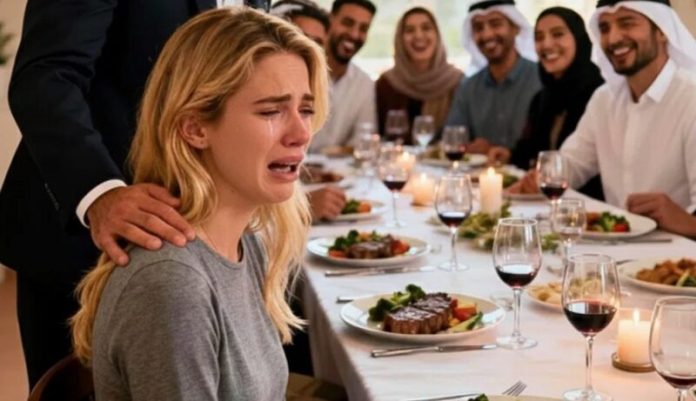
For six months, I lived between two worlds — my own simple, straightforward American one, and the new, layered, intricate Eastern world of Rami’s family.
During that time I heard small jabs, cautious remarks, cool comments — not malicious, more like they were measuring me, testing whether I fit a role I hadn’t yet earned.
They spoke Arabic around me, convinced I understood barely a few basic words.
No one suspected that I didn’t just know the language — I loved it. That I had spent years studying it, listening to it, absorbing the melody of their speech so that one day I could become part of that world. I didn’t reveal it — not out of cunning, but out of fear. Fear of making a mistake, stepping somewhere I hadn’t yet earned a place.
That evening we were sitting in a grand hall — Rami’s family was celebrating his parents’ anniversary. Laughter, teasing, little jokes echoed around the table. The air smelled of cinnamon, cumin, and roasted lamb. I sat quietly, smiling politely, hiding the fact that I understood almost everything.
Then Rami leaned slightly toward his brother and said:
“She tried to make mansaf again today. Can you imagine? She even asked where to add the yogurt.”
His brother snorted:
“Yogurt! Americans are incredible.”
Their laughter echoed through the room.
I kept smiling — not because I was pretending. I genuinely didn’t see mockery, only confused amusement. I knew how sacred the kitchen was to them, how unbreakable their traditions were. And me — clumsy, curious, too direct — must have looked like a child learning to walk by watching adults.
Rami’s mother, Farida, watched me closely, as if studying every gesture. But there was no contempt — only uncertainty, and the worry of a mother protecting her son.
And suddenly, I understood something very clearly:
they liked me.
They were simply afraid to admit it.
My phone vibrated in my purse.
A message from my dad:
“Sweetheart, don’t stay silent. If something’s wrong — we’ll be on the next flight.”
I sighed. My father had always been my defender, a man who would tear the world apart to protect me.
But this time I didn’t need protection — I needed courage.
I deleted the message and returned to the table.
When Rami raised his glass to make a toast, I finally decided to take a risk.
He spoke in Arabic:
“May this evening remind us that family is our heart. And may we always have beside us the one who understands us, even when we speak different languages.”
Then he translated for me:
“He said he’s happy we’re all together.”
I placed my hand on his.
“He said much more than that,” I whispered — in Arabic, clean and confident.
The room fell silent at once.
Even the candles seemed to stop flickering.
Rami blinked.
“You…,” his voice cracked. “You speak Arabic?”
“For a long time now,” I said softly. “I was just waiting for the right moment.”
Rami’s brother exhaled sharply:
“So you understood all of us?!”
“Almost every conversation.”
Rami’s father leaned back and burst into loud, genuine laughter.
“And here we thought she was just shy!” he exclaimed. “Seems my children aren’t the smartest people in this house.”
Farida stood up. Silently, gracefully, she walked around the table and came to me.
For a moment, fear clenched my stomach — what if they didn’t like this after all?
But she took my face in her hands — the way only mothers do.
“You gave us time to get used to you,” she said in her language. “That is wise. And… beautiful. You want to be one of us. I see that. Forgive me if I was sometimes harsh.”
I nearly burst into tears.
Rami looked as if he’d forgotten how to speak.
Finally, he whispered:
“I love you even more than I did ten minutes ago.”
“That’s good,” I smiled and took his hand. “Because something changes now.”
I stood.
“I understand what you’ve all been saying. All this time. And I know much of it wasn’t meant to hurt — you just wanted to make sure I was right for your son… and your family.”
Farida nodded.
“We had to be sure. You come from another world.”
“Yes,” I agreed. “But I didn’t come here to break your world — I came to become part of it.”
Rami’s brother scratched the back of his neck, embarrassed.
“I think we’re the ones who weren’t very delicate.”
Rami’s father lifted his glass.
“Then let’s start anew. To our new daughter.”
Everyone at the table raised their glasses.
On the way home, Rami held my hand so tightly, as if afraid I might disappear.
“Why didn’t you say anything earlier?” he asked, pulling me close in the car.
“I wanted them to accept me for real. I didn’t want to be ‘the one who already knows everything,’ but the one who wants to learn. I wanted your family to get used to me without pressure.”
He stroked my cheek.
“I’m proud of you. And grateful. But… habibti… now I’m a little afraid of you.”
“Well, of course,” I laughed. “You have no idea how much I’ve heard!”
He laughed too.
And for the first time in a long time, I felt like we were truly us.
Not two worlds — but one family slowly growing together.
A week later Farida arrived with a box.
“This…” she said shyly, handing it to me, “is our family recipe for mansaf. Since you want to learn — learn it properly.”
I hugged her.
And this time — she hugged me back.
When Rami and I announced our wedding date, no one was surprised.
Everyone already knew:
I had become part of the family.
And they had become part of me.
It was the most beautiful trap of my life.
Not the kind that imprisons.
The kind that holds you — gently, and forever.