That day, I did not cry. Not because I didn’t want to — for forty-two years we lived side by side, survived poverty, illnesses, rare moments of joy, and small victories. But the tears seemed stuck deep inside me, turned to stone. They didn’t come — neither during the farewell, nor later, when the neighbor brought me some porridge and said sympathetically, “Stay strong, Mrs. Valentina.”
I only nodded, smiled politely, and closed the door.
My son, Andrzej, stayed by my side the whole day. Tall, elegant, in an expensive black suit — probably worth more than half a year of my pension. He held me by the arm, as one is expected to… but his hand was cold. Not from the weather — from the lack of feeling. As if he wasn’t guiding his mother, but fulfilling an obligation.
At the wake he delivered the most beautiful speeches. Loud, confident, with theatrical pauses. Everyone nodded, delighted:
“What a man! What a good son!”
And I sat aside and watched. I looked at his face — familiar, yet strangely foreign. My eyes lived in his gaze, his father’s nose… but the smile was like a mask.
On the third day he came to see me. I made coffee — my husband always liked it strong, with milk. The habit remained, though he was gone.
Andrzej sat at the table, placed car keys and documents in front of me.
“Mom,” he began quietly but firmly, “I’ve thought it all through. It will be better if you move to a care facility for people your age. Peace, quiet, clean air, supervision. You shouldn’t stay alone in such a big apartment. You know how hard it was for Dad at the end… the same could happen to you…”
He didn’t finish, but I understood. The unspoken word hung between us.
I drank the coffee. Hot, burning — at least it hid the trembling of my hands.
“The apartment…” he continued, “and the business… they’re already mine. Dad transferred everything to me last year. He always wanted what was best for me. To avoid conflicts.”
I knew. I knew my husband had transferred everything to our son without asking me. I didn’t protest. I thought: “It doesn’t matter. The important thing is that our son loves me and will take care of me one day.”
I was naïve.
“You have to understand, Mom,” he said, “you won’t manage on your own. You’re tired. You’ve grown old.”
He said that last word almost gently, as if giving a diagnosis. As if I were a worn-out object.
“When?” I asked calmly.
He looked like he expected tears, hysteria, begging. But I only wanted an answer.
“Tomorrow morning,” he replied. “I’ll come for you. Everything is arranged. You don’t have to pack much, everything is provided there. Just take the essentials. And don’t worry… I’ll visit you. Of course.”
He lied. I knew he would never come.
In the morning he arrived in his shiny Mercedes. I came out with a suitcase: my husband’s photo, some savings, my passport, and my old recipe notebook — our favorite dishes.
Andrzej tossed the suitcase into the trunk like a sack of potatoes. He opened the door, I got in. We drove off.
We drove for a long time. The city disappeared, then the suburbs, until finally houses gave way to dense forest. The smooth road turned rough.
“Andrzej,” I said carefully, “where exactly is this care facility?”
He didn’t answer right away.
“You’ll understand soon,” he said indifferently.
After twenty minutes he turned onto a narrow, barely passable path. The car jolted over the holes. Finally, it stopped.
He got out. Opened my door. I looked around.
Silence. Forest. No house, no fence. Only trees.
“Here,” he said. “Here is your place.”
I looked at him. His face was calm. Unmoved.
“What does that mean?” I whispered.
“Exactly what you hear. It’s quiet here. Nobody will bother you.”
He set the suitcase beside me.
“You have food for a few days. The rest… you’ll manage somehow. You’re a smart woman.”
I froze. The world fell silent, leaving only emptiness.
“You… you’re leaving me here? Alone?”
He shrugged.
“I’m not leaving you. I’m just… letting you go. You need peace, and I need to focus on my own life. My wife and kids don’t need an old woman on their backs.”
He said it almost cheerfully.
“Andrzej… I am your mother.”
“You were, once,” he replied. “Now you’re only a burden.”
He got in the car. Closed the door.
“PLEASE!” I ran after the car. “I’ll give you everything! The apartment, the money — everything! Just don’t—”
He didn’t look back.
The engine roared, then faded into the distance.
I sat on the ground. Blood seeped through my stockings. My body hurt — but my soul hurt more.
I took water and chocolate from the suitcase. Maybe that was how he quieted his conscience.
I stood up. I walked forward. Only so I wouldn’t lie down and give up.
After three days I reached a dusty road. A truck driver stopped.
“Where are you going, grandma?” he asked kindly.
“To the city,” I whispered.
He helped me climb in. The radio played. I sat silently and cried.
In the city, I went to the police. I told them everything.
“Ma’am,” the officer said, “unfortunately there is no evidence. No violence occurred. He left you alone. And you survived. This is not a criminal offense.”
I walked out. It was drizzling. People rushed by. No one looked at me — an old woman with a suitcase.
I went to the library. Free internet. I wrote, asking for help. To newspapers, offices, human rights groups.
A week later a journalist called:
“Mrs. Valentina, please tell your story. We will publish it. People need to know.”
They published it. The article spread widely, thousands read it.
The next day Andrzej called:
“Mom… what have you done?! I lost my job! My wife left! My children are ashamed of me!”
“I understand,” I replied. “Exactly the way you treated me.”
“Please… I’ll take you home. I’ll give everything back. Just stop!”
“No,” I said. “I don’t need your apartment. I just want you to understand: a mother is not garbage.”
A week later he came. He knelt. He cried. He brought flowers. He said:
“Mom, I love you.”
And I… forgave him. But I didn’t return.
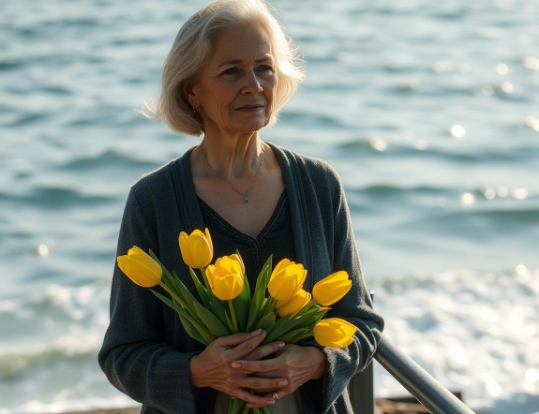
Now I live in a small room by the sea. My son visits me every week. I don’t forget the past, but it no longer burns.
I live. Slowly, peacefully, by my own choice.