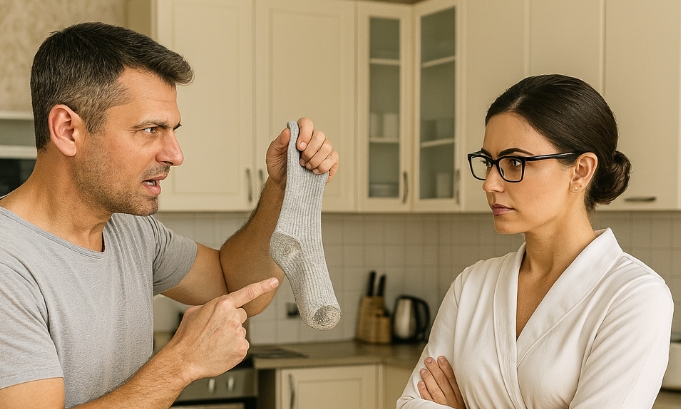
“Vitya, are you serious right now?”
Natalia froze in the middle of the kitchen, still holding the iron in her hand.
“Do you really think I spend the whole day at the office just shuffling papers, and at home… relaxing?”
Steam burst from the iron in a sharp cloud, but she didn’t even turn around.
Her gaze was fixed on the man sprawled across the couch as if he were the king of the apartment. Crumbs on his lap, remnants of his “snack” on the carpet, football on the screen.
Viktor clicked the remote lazily.
“Natalya, don’t start. I’m just stating facts. Everything’s automated now: the washing machine washes, the dishwasher cleans, the robot vacuum hums around. You just press the buttons — that’s your whole ‘domestic front.’
I, on the other hand, have a construction site, workers, deadlines… I’m allowed to come home and relax.”
Something inside Natalia snapped.
The very thread of patience she had been stretching for twelve years finally broke.
She slowly turned off the iron.
“So everything I do is just ‘pressing buttons,’ according to you?”
“Well, yeah,” he didn’t even bother sitting up straighter.
“It’s not like you wash clothes by hand in the river. The machines do everything.”
Natalia looked at the chaos around her: the mountain of laundry, scattered things, dirty dishes. Then looked back at him.
“Perfect,” she said calmly. “Then let the machines handle it.”
She left the room so quietly Viktor didn’t even realize where she went. He was sure she’d gone to the kitchen to make dinner.
But Natalia walked to the bedroom.
She took the half-finished book she only dreamed of reading in the evenings, poured herself mineral water, turned on the lamp, and settled into bed.
No guilt.
No shame.
Forty minutes later, the bedroom door flew open.
“Natalya, what’s going on? It’s late, there’s no dinner. Did you fall asleep?”
She looked up from her book.
“No, Vitya. I’m resting. Just like you.”
“And dinner?”
“Press some buttons. You’re great at that.”
He snorted.
“Very funny. I’m starving!”
“And I’m tired. I had reports today, document checks, calls.
So the appliances are your best friends. Use them.”
Viktor slammed the door and stomped off to “boil dumplings,” banging pots and pans like a battle was raging in the kitchen.
The next day, the collapse began.
“NATASHA! Where are my BLUE socks?!”
“No idea,” she answered cheerfully while adjusting her blazer. “Wear whatever you find.”
“They’re in the basket! Why aren’t they washed?!”
“Because the washing machine doesn’t pick socks off the floor by itself. Try pressing a button — you’re the expert.”
Viktor stood there in nothing but underwear, wearing one sock, with pure horror on his face.
The following days turned into a mini-apocalypse.
The apartment quickly started resembling a movie set for a survival drama. Dust, grease, dirty dishes, piles of laundry, socks everywhere.
Natalia cleaned up after herself.
Artyom, their teenage son, caught on quickly: he washed his own dishes, did his laundry, even vacuumed a couple of times.
But Viktor…
He stubbornly waited for his wife to return to her usual “default housemaid” schedule.
The final blow came on Friday.
“Natalya, my mom is coming on Sunday,” he announced proudly.
“So stop this nonsense. We need to clean, cook, get the house in order.
I’m going fishing tomorrow, so take care of it yourself.
You don’t want to embarrass yourself in front of my mother, do you?”
Ah yes. His mother — her biggest critic and lover of perfect order.
Natalia smiled sweetly.
“Of course, Vitya. Wonderful idea.”
On Saturday, Viktor returned home late, fully expecting sparkling cleanliness.
He opened the door… and froze.
The smell of trash. Dust. Dirty dishes. Clothes everywhere.
And silence.
“NATASHA!” he roared, running into the bedroom.
“Yes, Vitya?” — she didn’t even close her laptop.
“Everything wonderful?”
“My mom is coming tomorrow! Why didn’t you clean anything?!”
“And why should I? You said appliances do everything.
So let them.
I didn’t stop them from showing initiative.”
Viktor realized he was doomed.
The next morning his mother arrived. Elegant, neat, not a wrinkle on her clothes.
She barely stepped onto the rug before her face darkened.
“Vitya… what IS this?”
Natalia came forward beaming.
“Hello, Zinaida Mikhailovna! We’ve changed our lifestyle.
Vitya enlightened us: housework is nothing.
The appliances do everything. See? They worked very hard.”
His mother slowly turned to her son.
“Is this true?”
“Mom… well… Natalia is exagger—”
“Exaggerating?!” she thundered.
“Have you lost your mind? Do you have any idea what running a home means?
Who do you think holds everything together?
Did you seriously believe the dirt disappears by itself?!”
Viktor shrank.
“Natalya,” — Zinaida said gently, — “come with me to a café. Let’s have coffee.
We’ll leave this lord to deal with the consequences of his own… enlightenment.”
The women left arm in arm.
Viktor remained alone in the pigsty of his own laziness.
And for five straight hours he cleaned the apartment, cursing the robot vacuum, the dishwasher, and his own arrogance, until he understood one simple truth:
Buttons are the smallest part of the work.
When they returned, the kitchen was spotless.
Viktor — sweaty, exhausted, and humbled.
Natalia made him dumplings.
He ate silently, then finally said quietly:
“Natalya… I’m sorry. I truly didn’t understand.”
“Do you understand now?”
“Yes. And… I’ll never say anything about ‘just pressing buttons’ again.”
From then on, everything changed.
Viktor stopped treating housework as something trivial.
He started doing grocery runs, cleaning occasionally, and even learned to use the washing machine without disasters.
And most importantly — he learned that respecting someone else’s labor in a family is worth far more than his own laziness.
And Natalia, watching her husband load the dishwasher without grumbling, knew:
Her little “revolution” had worked.