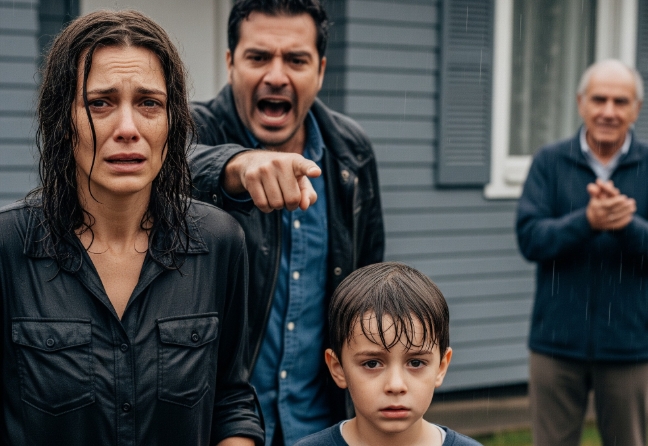
When my husband asked me for a divorce, I was only twenty-eight and had a three-year-old child. Although the breakup itself wasn’t a huge surprise — for a long time he had behaved as if he lived in a world where I no longer existed — what stunned me was the cold indifference with which he announced his decision.
“I don’t love you. I want a different life,” he said while scrolling through his phone.
That same evening he packed his things.
By the next morning, his entire family knew… and of course, they had plenty to say.
His mother called me under the guise of “giving advice.” In reality, she only wanted to humiliate me.
“I always knew this would happen,” she said venomously. “You have no education, no money. What exactly are you planning to do? Become a burden?”
Before I could react, she added:
“To be honest, I just hope you don’t end up on the street with the child. Nobody wants to see that.”
But the worst came weeks later, when I dropped my son off for the weekend with his father. His sister-in-law stood waiting in the doorway, arms crossed, wearing a smirk of malicious triumph.
“Already looking for a shelter?” she sneered.
Her words pierced me like needles.
I was devastated, terrified, without a stable income, watching my last savings vanish day by day. The apartment we lived in belonged to him, so I had to move out. I rented a tiny room in a cheap boarding house — an old mattress, damp walls, a window that didn’t close properly. Every night, after my son fell asleep, I cried in silence, wondering how my life had sunk so far.
One afternoon, while he was playing with a plastic toy wagon, he looked up at me with a trusting smile and said:
“Mom, when I grow up, I want us to live in a nice house. You can do it.”
“You can do it.”
Those two words awakened something in me — something I thought I had lost: dignity.
That same night, I wrote out a plan: get a job, learn something useful, save every cent I could, and never again let anyone treat me like garbage. I didn’t have a perfect plan, contacts, or money. But I had a new, fierce determination. And I had a motive: my son.
I didn’t realize that this decision — made in a damp boarding-house room — would begin a decade of hard work, invisible sacrifices, and small victories that would eventually grow into something unimaginable.
I also never expected that ten years later I would be driving a new car, turning onto the very street where I had once been humiliated… with the keys to my own house in my hand.
The first months were chaotic. I got a job as a receptionist at a dental clinic — poorly paid and demanding. I took every shift offered, including Saturdays. The salary barely covered the boarding house rent, food, and childcare, but at least it was something.
My nights became my escape. After my son fell asleep, I threw myself into online learning, signing up for free courses in management and customer service. I learned how to use basic software, write professional emails, and maintain organized schedules. I filled a notebook with notes — messy, crossed-out, but full of hope.
A year later, the clinic opened a position for an administrative assistant. I applied, nervous but honest.
“I don’t know everything,” I told the manager, “but I learn fast.”
And that’s how it went. I got the job.
The promotion meant not only a higher salary but also a chance to prove myself. I managed inventory, suppliers, reports, and invoices. Sometimes it was overwhelming, but whenever doubt crept in, I remembered my ex-husband’s family predicting my downfall… and that pushed me forward.
When my son turned six, we moved out of the boarding house into a small apartment on the city’s outskirts. It wasn’t luxurious, but it had clean windows, dry floors, and room to breathe. That first evening, I hugged him and cried with relief.
Life, however, still didn’t let me rest. The child support my ex provided was irregular and minimal; sometimes months passed with nothing. I stopped expecting fairness and simply worked harder. I took a second remote job as a virtual assistant for a company in Chile. I slept little, was constantly tired, but each month I managed to save something — five dollars, twenty, fifty.
After four years at the clinic, my skills were solid. I began applying for better positions at larger companies. After several rejections, a logistics firm finally hired me as an administrative coordinator. That job changed everything: decent pay, health insurance, stability.
For a while, I thought that was enough. But two years later, a colleague told me about a business management diploma program. It cost more than I could afford, but they offered installments. I took a deep breath and enrolled.
The program opened my mind. I learned processes, strategy, leadership. For the first time, I began to see myself as someone with real potential. My long-shattered self-esteem started to rise.
Not long after, an unexpected opportunity appeared: the company needed a supervisor for a new distribution center. I applied, prepared for the interview for weeks, and despite my doubts — I was chosen.
That night, staring at the contract with its new salary, I knew something had changed forever. I wasn’t just surviving. I was building something.
I didn’t expect destiny to prepare one last, almost poetic scene for me: a return to the same neighborhood that once despised me… but this time as a homeowner.
Ten years after the divorce, my life was completely different. I had a stable position, an income I never imagined, and a healthy, confident son who was proud of me. He had grown up watching me fight and often told me:
“Mom, you can handle anything.”
And I was finally beginning to believe it.
With my savings and an approved mortgage, I began the process of buying a home. I searched for months. I wanted a bright place with a small garden where my son could study or read in the sun. Nothing extravagant — just something that was ours.
When the agency sent me a list of available houses, one location caught my eye. A familiar street. Very familiar. The exact street where my ex-husband’s family lived. I felt a sudden twist in my stomach. Was it a sign? A cosmic joke? Or an opportunity?
I went to see the house with the agent. When I arrived, I recognized everything: the facades, the trimmed trees, the corner where I once cried silently after a cruel remark. But seeing the house for sale — white, simple, well-kept — I felt unexpected peace. This wasn’t revenge; this was closure.
I bought it.
A month later, on moving day, I drove onto that same street in a new car I had earned with my own work. My son, now a teenager, sat beside me. He rolled down the window, looked around, and said, surprised:
“Isn’t this… that street?”
I nodded with a calm smile.
“Yes. But this time, we’re here for our own reasons.”
As I parked, I saw my ex-husband’s mother coming out of her house. She froze when she saw me. Her expression shifted from disbelief to something I never expected to see on her face: quiet respect.
I didn’t need to humiliate her. I didn’t need to say a single sharp word.
My presence, my house, my life… spoke for me.
She took a few hesitant steps forward.
“You’re moving here?” she asked faintly.
“Yes,” I answered simply. “This is my home now.”
I didn’t add anything else. My voice held no hatred — only strength.
My son got out of the car, proudly grabbing one of the boxes. He understood the meaning of this moment too.
We walked inside. Freshly painted walls, the smell of new wood, sunlight streaming through the windows — it all filled me with something indescribable. This wasn’t triumph over someone else.
This was triumph over the woman I used to be.
When evening came, as we unpacked the first things, my son hugged me from behind.
“Mom, you did it.”
And for the first time, hearing those words didn’t make me cry.
It made me smile.
Because the truth was simple:
“I was never the woman destined to fail, as they said.”
I was the woman who could rise after every fall and build a new life with her own hands.
And from that day forward, every time I open the door to my home, I remind myself:
The greatest victory wasn’t returning to that street…
The greatest victory was rebuilding myself.