When I first met Richard, little Natalie had just turned four. She was still small enough to sleep curled against me like a kitten, and still young enough that the world seemed full of shadows she couldn’t name. Her father—my late husband—had passed away from a sudden heart attack when she was only a year old. She had no memories of him, only the photographs and the softness in my voice whenever I spoke his name. The grief had hollowed out spaces in both of us, though I tried to hide mine for her sake.
And then, one September afternoon, I met Richard.
He was the kind of man who listened not because he was waiting for his turn to speak, but because he genuinely cared. He worked as a pediatric occupational therapist, and the gentleness that job required seemed woven into every part of him. His laugh came easily, his patience never seemed to run thin, and—most importantly—Natalie adored him.
She clung to him the first time he helped her fix a broken doll arm. After that, she followed him everywhere, asking him questions about birds and clouds and how cars worked. Almost without realizing it, Richard became part of our daily life.
When we got engaged, Natalie was the one who cried—not me. She wrapped her arms around him and whispered, trembling, “Can I call you my new dad now?”
Richard knelt, brushing her hair from her forehead. “Only if you want to,” he said softly. “But I would be honored.”
From that night forward, he was simply “Daddy.” Not a replacement—never that—but a new, gentle presence who filled the corners of our home with warmth again.
We planned the wedding for early spring. But then Richard’s beloved aunt—his second mother in many ways—passed away unexpectedly. The family was devastated, and he couldn’t imagine celebrating in the middle of so much sorrow. So, we postponed the ceremony by six months.
The delay brought complications, but in the end, it made the wedding even more meaningful. By the time autumn rolled around, we were ready—emotionally and practically—and more excited than ever.
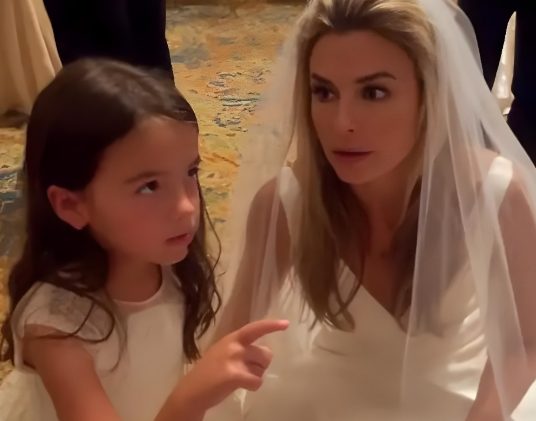
The day of the wedding felt like a dream. Golden leaves littered the ground outside the venue, and soft music drifted through the hall. Friends and family filled the room, their joy almost tangible. Natalie, in a tiny cream-colored dress, looked like a fairy sprite, her hair gathered in soft curls. She held her bouquet with the seriousness of someone performing a sacred task.
After the ceremony, laughter and music swirled through the reception hall. People embraced us, toasted us, clapped us on the backs. Richard was radiant. I couldn’t remember seeing him smile that widely.
I was chatting with my cousin when Natalie tugged on the hem of my dress. Her face was pale, her eyes wide and brimming with tears.
“Mom,” she whispered, her voice shaking, “you need to look at Daddy’s hand.”
I blinked, confused. Richard stood across the room, talking animatedly with a group of his coworkers. Nothing about him looked strange.
“Honey,” I said gently, “what do you mean?”
Her lower lip trembled. “I don’t want a new dad,” she whispered, shoulders shaking. “Mom, please… come.”
The fear in her voice was enough to stop my heart. I excused myself and followed her across the room. Every step felt heavier than the last—my mind racing through possibilities. Had she seen something? Was she overwhelmed? Did someone say something to her?
As we approached, Richard turned, smiling broadly. “There you two are! I was just bragging about Natalie’s dance moves—”
But Natalie didn’t smile. She took his hand, small fingers trembling, and held it up for me to see.
Only then did I understand.
The skin below Richard’s left thumb was swollen and slightly reddish, marked by a faint but unmistakable indentation—a band-shaped indentation.
His wedding ring.
But that wasn’t the issue. Earlier, before the ceremony, a part of the floral arch had fallen, scraping across his left hand. His ring had snagged and bent slightly, pinching his skin. The discomfort had grown, and when a coworker offered to help him slide the ring off so the swelling could ease, he’d reluctantly removed it and slipped it into his jacket pocket.
Natalie, seeing his bare finger, had assumed the worst.
She thought he had taken it off because he didn’t want to be her dad anymore.
My chest tightened.
I knelt beside her. “Sweetheart,” I murmured, brushing her wet cheek, “Daddy didn’t take it off because he doesn’t want to be your dad.”
Richard crouched down immediately, eyes soft and brimming with concern. “Natalie,” he said gently, taking her hands in his, “your mom and I love you so much. I would never, ever leave you.”
“But… your ring,” she sniffed.
He reached into his pocket and pulled it out—the gold band bent slightly out of shape. “It was hurting my hand,” he explained. “See this part here? It got stuck earlier. I just need to have it fixed, that’s all. But taking it off doesn’t mean anything bad. You’re my daughter, okay? Forever.”
Natalie stared at him as though waiting for confirmation from the universe itself.
Richard leaned forward and pressed his forehead to hers. “You’re stuck with me,” he whispered. “And I’m the luckiest man in the world because of it.”
Her eyes filled with fresh tears—this time not of fear, but relief. She threw her arms around his neck. He scooped her up, laughing softly as she clung to him.
The music seemed to swell around us. For a moment, it felt like the entire room was wrapped in warmth.
Later that night, when the party slowed and the lights dimmed, Richard danced with Natalie in the center of the room. She placed her head on his shoulder, her small fingers curled into the fabric of his shirt. Guests paused to watch, some wiping at their eyes.
There was grief in our past, yes. But in that moment, watching them sway slowly under the golden lights, I realized something:
We were whole again.
Not because we had forgotten loss, but because love—unexpected and gentle—had filled the spaces where the shadows once lived.
And this time, the story ended not with fear, but with hope.