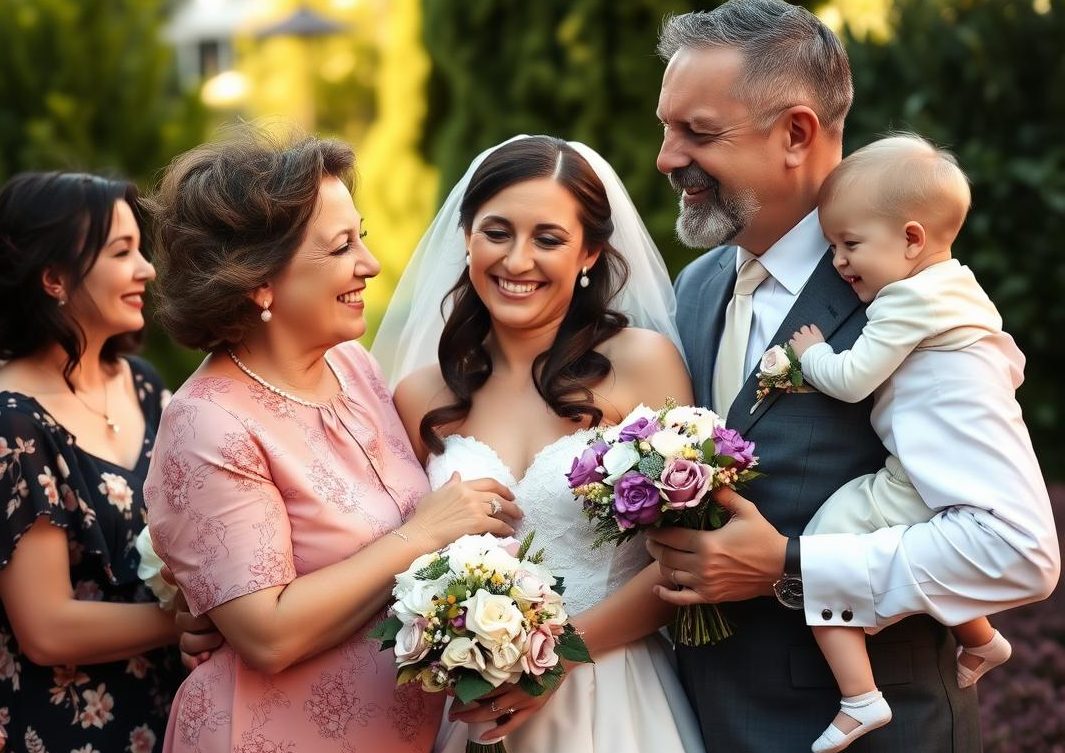
When I came back from Brighton, where I’d spent a week attending my son’s civil ceremony, I felt nothing but joy. Not because of restaurants, festivities, or wedding chatter—none of that mattered. What filled me with happiness was seeing the truth with my own eyes: Ben was genuinely content, and his Madeleine was gentle, gracious, and luminous in every way. They’d tied the knot quietly, just the two of them and a small circle of loved ones, then celebrated with a modest dinner at home. For them, sincerity mattered far more than spectacle.
Returning to our little village near Oxford—a place where whispers travel faster than the wind—I barely had time to unpack before my neighbor, Edith Wilkins, barged into my kitchen.
“So? How was the wedding? What did the dress look like? How many people came?”
“There wasn’t a big ceremony,” I told her. “Just the paperwork and a calm family meal.”
“Oh? Trying to save money, were they? My Andrew had a wedding with two hundred guests at the Grand Hotel!”
I forced myself to stay polite. Her Andrew, who was now on marriage number three, was still her favorite topic—she bragged constantly about that lavish wedding, though she never actually attended it. The man hadn’t been home in half a decade.
“Ben has something far more precious,” I said evenly. “Real love. No extravagance, just honesty.”
“And this wife of his—what does she do for a living?”
“She’s a paramedic. They met when Ben was working on his ship—you know he’s a sailor.”
“Hmph… Well, he’ll abandon her eventually. She isn’t suitable for him.”
Her remark hit me like ice water. I didn’t respond. I simply closed the door behind her. After that, we barely exchanged a greeting.
Half a year later, Ben completed his contract and moved in with us, Madeleine by his side. I was delighted—having my son and his wife under my roof again made me feel whole. They adapted quickly: Madeleine took a position at the local clinic, and Ben started working at a garage. Life settled into a lovely rhythm of shared chores, easy conversations, and plans to extend the house.
But Edith didn’t ease up. Her visits became more frequent, her comments nastier.
“What possessed him to marry that? That scar on her cheek—ruins half her face! Your boy is so handsome, and yet—”
“That woman is the person he loves,” I answered sharply. “And she’s worth far more than your nasty opinions.”
Yes, Madeleine’s scar was visible—but once you knew her, you barely noticed it. She was quiet, compassionate, relentless in her desire to help. The village quickly grew fond of her; she was the one people called, day or night, whenever someone needed aid.
And then came the night that changed everything.
A fire erupted in the old shed beside the clinic. People rushed out with buckets, shouting instructions over the crackling flames. Someone yelled, “A child’s still inside—Amy’s trapped!”
Madeleine didn’t pause. She charged straight into the blaze, weaving through smoke and falling wood. Moments later, she emerged coughing, carrying five-year-old Amy against her chest—just before the roof collapsed behind them. Aside from a bit of smoke inhalation, the child was safe.
That silenced Edith more effectively than any words ever could.
Madeleine sat with Amy for hours, refusing to leave her side. The little girl’s parents cried as they thanked her.
“You saved our world,” they whispered.
“Someone once saved me,” Madeleine said softly. “I grew up in Bosnia during the war. I was seven when the shelling started. My home burned down. My family didn’t survive. A British soldier carried me out. He died protecting me, but before he did, he gave me this—his medal. I’ve worn it ever since.”
She removed the chain. Amy’s grandfather, Robert Hadley, turned ghostly pale.
“That medal… I passed it to my son when he enlisted. He never returned. His name was James.”
His hands shook as he touched the metal. After thirty long years, he finally understood: his son had died saving the woman who had just rescued his granddaughter.
“Keep it,” he said, voice trembling. “You’ve more than earned it.”
A month later, Madeleine, Robert, and I visited James’s grave together. Robert placed flowers on the stone and cried—not from sorrow, but from gratitude that the truth had finally been revealed.
As for Edith? She never invaded my doorway again. Now she only peers from behind her fence, too embarrassed to say a word.
Sometimes a person’s heart shines brighter than any outward flaw. Sometimes a scar is proof of courage. And a son’s choice in love is not a topic for idle tongues.
That’s my so-called “frightening” daughter-in-law. The greatest blessing our family ever received.