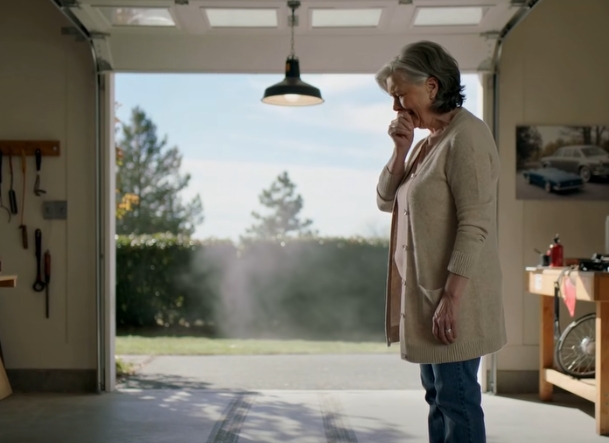
The garage smelled of oil and time.
For twenty years, Dennis had spent his nights here, under the lamp’s glow, surrounded by wrenches and paint cans.
He used to say that a car wasn’t just metal—it was a heart he brought to life, only to give it a second chance.
I would always laugh when he’d caress the hood of his old 1967 Mustang, treating it like a living being.
After his death, I sometimes came here just to sit.
Sometimes it even felt like I could hear the sound of a key turning, as though he were still working.
But today, the garage was empty.
I stood on the concrete floor, unable to breathe.
The spot where the car used to be was as clean as if it had never existed.
When I heard the tires crunching on gravel, I knew.
Brian stepped out of the car, avoiding my gaze.
Vanessa sat in the passenger seat, phone in hand, not even bothering to get out.
“Mum,” he said. “I need to explain something to you.”
“Where is it?” I barely recognized my own voice.
He rubbed his face. “I sold it.”
The words pierced the silence like a blow.
“What did you do?”
“We needed the money. Vanessa has a meeting in Paris with investors. It’s our chance.”
I looked at him and didn’t recognize him. His face no longer held the boy who used to run after his father with a wrench, helping him “fix the monster.”
Now, it was an adult man, ready to sell everything that wasn’t his to chase someone else’s ambition.
“That car was his life, Brian. He was building it when you were still learning to walk.”
“He’s not here, Mum. It’s just metal.”
Vanessa got out of the car, smiling that cold smile that never cracks.
“Carol, no need for drama. Dennis would want you to move on.”
I looked at her.
“Dennis would want his memory respected.”
“Memory doesn’t pay the bills,” she shrugged. “Relax. We’ll send you a postcard from Paris.”
They drove off.
I stood alone in the empty garage, listening to the wind whistling through the cracks.
I wanted to scream, but the sound caught in my throat.
I didn’t cry.
Crying meant accepting it.
The phone rang in the morning.
“Mrs. Bennett?” a man’s voice asked. “This is from the Redwood Classics dealership.”
“Is something wrong?”
“Your son sold us the car. But… in the glove compartment, we found an envelope with your name on it. And a letter. And something else.”
“What exactly?”
“It’s better if you come in person.”
I drove there, my fingers trembling.
The dealership was outside the city, nestled among old warehouses and shiny cars parked under lights, like jewels.
A man in his fifties, wearing a mechanic’s uniform, greeted me. His badge read “Michael.”
“Are you Carol Bennett?” he asked. “Then this is for you.”
He handed me a sealed envelope. The handwriting—Dennis’s.
I pressed the letter to my chest before tearing it open.
“My Carol, if you’re reading this, it means I didn’t manage to tell you everything.
I left something in the car—not just a memory.
It’s the answer to a question you don’t even know you’ve been asking.
Look under the seat. And please, don’t trust anyone until you understand what this means.”
Inside the envelope was another key. Small, brass, engraved with the letter D.
“Michael,” I asked, “Where is the car?”
He led me through the garage.
And there it was.
The car stood there—shiny, deep cherry red, as if it had just rolled off the assembly line.
I ran my fingers over the hood. The same smell—oil, leather, memory.
I opened the door, sat in the seat, and felt around under it.
There, in a hidden compartment, was a small metal safe.
The key fit perfectly.
Inside were a stack of documents and a flash drive.
The first page had the title:
“Redwood Motors: Bill of Sale. Seller—Brian Bennett. Buyer—Dennis Bennett.”
I didn’t understand at first. Dennis bought… his own car?
Michael, looking at the papers, let out a quiet whistle.
“Wait a second. This…” He pointed to the notary’s signature. “The date—was a month after his death.”
A chill ran down my spine.
“He… couldn’t have…”
“Unless he prepared everything beforehand,” Michael said. “Or someone signed for him.”
At home, I inserted the flash drive into my laptop.
A video appeared on the screen. Dennis, filmed a few weeks before his death.
“Carol. If Brian ever sells the car—don’t be mad. He doesn’t know what’s inside.
I left you something that was meant to protect you.
These documents are part of the life insurance policy.
Only you and the car’s owner can claim the payout.
I’ve put the car in your name. If anyone sells it without your consent, the deal will be null and void.
And… if you’re seeing this—it means I did it right. I love you.”
I closed my eyes.
It all became clear.
Brian sold the car, but legally, he had no right to.
The deal was void.
And when the insurance checks the documents, the money from the car will return—along with another sum Brian didn’t even know about.
Two days later, I was back at the dealership.
Michael greeted me with a smile.
“Mrs. Bennett, the insurance company contacted us. The sale’s been annulled. The car is yours again.”
“Thank you,” I said.
He handed me the keys.
“Dennis had it all figured out. He was a smart man.”
“Yeah,” I smiled. “He knew who to protect.”
When Brian called that evening, his voice was restrained.
“Mum… I don’t understand. The car was returned. What’s going on?”
“It’s fine, son,” I said calmly. “Your father left me a little gift.”
“You knew?” His voice broke. “Did you set this up?”
“No, Brian. Your father did it. He just knew who he could forgive and who he couldn’t.”
There was silence on the other end.
Then the short beeps.
A week later, I was back on the highway—for the first time in many years.
The engine purred, the sun reflected in the mirrors.
I drove to the place Dennis always wanted—along the coast.
In the glove compartment lay a photo: the two of us by the garage, his hand on mine.
On the back was the inscription:
“When they sell the dream—just bring it home.”
I smiled and pressed the gas pedal.
The car surged forward, as if it knew the way.