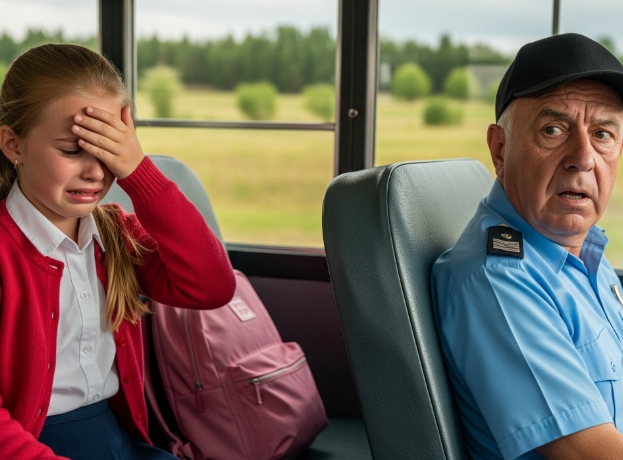
For more than ten years, Manuel Herrera had been driving school bus No. 27B along the familiar streets of quiet San Vicente. He knew every curve, every crack in the asphalt, every boy and girl who stepped onto the bus each morning. But for the past two weeks, one troubling thought wouldn’t leave him alone: seven-year-old Lucia — a quiet, delicate girl who always chose the same seat in the middle on the right — cried every single day.
At first, Manuel assumed it was just adjustment. Some kids struggle with noise, with schoolwork, with being apart from home. But Lucia cried only here, on the bus. She slumped forward, pressed herself against the window, and the stretched-out sleeve of her old sweater served as a constant handkerchief.
One morning, while the other kids climbed aboard in their usual whirlwind of chatter and laughter, Manuel noticed that Lucia was wearing the same thin sweater again — despite the unexpectedly cold wind sweeping through the city. Her eyes were reddened, as though she had spent the entire night in tears. When she tapped her card on the reader, something sharp twisted inside his chest. Everything was absolutely not “fine.”
That evening, after dropping off the last group of students, he saw that Lucia remained seated as if unaware the ride was over. Only after he gently said:
“Lucia, sweetheart… we’ve arrived. Is something wrong?”
…did the girl slowly rise, nod, and walk out — as though she carried an invisible weight on her shoulders. He watched her disappear around the corner, and at that moment a small spiral notebook fell to the floor.
Children rarely forget their things — their backpacks are practically an extension of their bodies. Manuel bent down, picked up the notebook… and heard a dull thump from under the seat, as if something had hit the metal floor. He crouched, shone his phone’s flashlight beneath the seat — and froze.
Deep inside, shoved as far back as possible, lay an object that certainly did not belong to a seven-year-old girl. His heartbeat quickened. He reached in, fully understanding that whatever he found was directly connected to Lucia’s tears.
When the object — a small metal case — landed in his hands, Manuel realized the situation was far more serious than he had thought.
His phone suddenly vibrated.
A message from an unknown number:
“Don’t get involved. Leave everything where it is.”
A cold grip closed around his throat. Someone knew he had found the case. Someone was watching.
That night, at home, he hesitated for a long time before opening the case. Finally, the latch clicked — inside were three bills, a tiny key, and a crumpled note written in a child’s handwriting:
“So he won’t get mad.”
Manuel felt his stomach clench. Money? A key? A note?
Who was the girl trying to appease?
And who was this “he”?
For several minutes Manuel sat frozen. Call the police? But without clear information, he might only make things worse — especially if the person sending the messages really was watching.
In the morning he made a decision: before anything else, he needed Lucia to know that he was on her side.
When the girl climbed aboard the bus, he greeted her with a gentle smile.
“Good morning, Lucia.”
She nodded, clutching her backpack tightly. In the mirror, he noticed a faint bruise on her wrist, barely visible beneath her sleeve.
His heart dropped.
When the bus reached the school, Manuel quietly added:
“If you ever need help… anything at all… you can tell me, okay?”
Lucia stopped. There was a visible, trembling fear in her eyes. She wanted to say something — but no words came. She simply stepped off the bus.
That evening, after finishing his route, he found a new drawing on Lucia’s seat. Hastily sketched lines. A small house. A large figure with raised arms. A tiny figure curled up in front of it.
At the bottom, in big letters:
“HELP.”
There was no doubt now. This was a silent cry for rescue.
That night, another message arrived:
“Stop checking under the seat.”
That was all Manuel needed to finally act.
The next morning, he went to the school psychologist, Mrs. Valdivia. He laid the drawing, the key, the case, and the note before her. The woman turned pale.
“This looks like serious domestic abuse,” she said. “We need to act immediately.”
The school contacted the police and child protective services. A discreet investigation began.
Meanwhile, Manuel continued working as if nothing had happened. But each time Lucia stepped onto the bus, he noticed a faint spark of hope in her eyes.
Three days later, the police reached out to him: the owner of the threatening number had been identified. It was the girl’s stepfather — a man with a violent criminal background. The key inside the case fit a locked drawer in their home. Inside, officers found money and a notebook listing various “punishments.”
The stepfather was arrested on the spot.
Lucia and her mother were moved to a safe shelter. The mother admitted she, too, had been living under constant threats and hadn’t known how to protect her daughter.
A few days later, Manuel was invited back to the school.
“Lucia asked to see you,” the psychologist said.
The girl approached quietly, timidly — but without the former terror in her gaze. She wore a new, warm sweater. In her hands she held a drawing. This time — a bright yellow bus. And a smiling driver.
On top, written neatly:
“THANK YOU.”
A lump rose in Manuel’s throat. He never saw himself as a hero. He simply noticed what others had overlooked.
But for Lucia, he had become the person who changed her life.
And in that moment, he understood:
sometimes one attentive glance is all it takes to save a life.