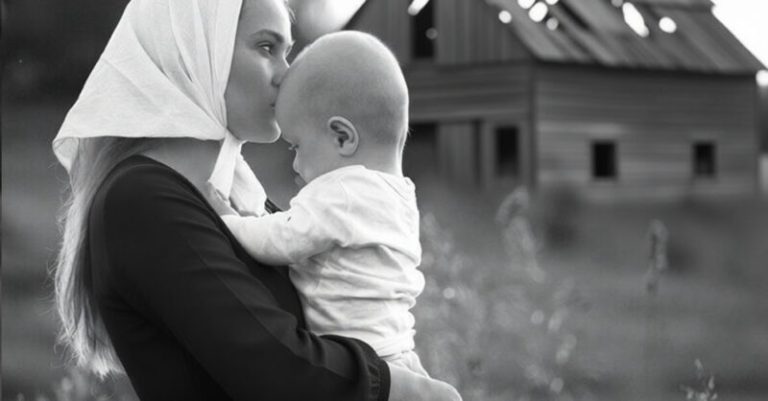
In the evening of 1946, a gloomy dusk settled over the small village lost deep within the forests. The sky, as if exhausted from the long day, faded into dull burgundy shades — as though it still carried the memory of the recent war. Margarita stood at the edge of an empty field, watching the thin, blood-red line of sunset above the dark pine crowns.
It was impossible to tell how long she had been standing there — a minute, an hour, or an entire eternity. Her whole life seemed to have become one long, sticky stretch of waiting.
The wind carried the smell of wet, decaying leaves, damp soil, and stove smoke. Somewhere in the distance an old fence crackled, and over the swamp a swarm of mosquitoes buzzed furiously. Margarita shivered, but didn’t move. It felt as if her feet had grown into the earth. The house waiting for her beyond the bend in the path was no refuge.
Inside was Antonina Petrovna — her mother-in-law, the embodiment of all the hardships of postwar life. Every glance was an accusation, every word a sentence.
“You promised…” the thought flickered again. “You gave your word to Leonid.”
Her husband, who had gone to the front, never returned. For two years now, no message had come — neither of life nor of death. But Margarita refused to accept the obvious. If she admitted he was gone, everything that held her upright would collapse. She had made a promise: to care for his mother until he came back. And for the sake of that promise she lived, breathed, endured.
With a deep breath, Margarita finally took a step — then another.
The house she called her own stood on the village outskirts: a sagging porch, time-gnawed steps, an old apple tree that had lost most of its bark. A faint yellow lamp glowed in the window.
She barely touched the door when a familiar heavy voice rang out:
“Where have you been wandering, you shameless woman? The children are hungry! Some hostess you are…”
Antonina Petrovna sat by the stove, wrapped in a black kerchief, her stern gaze fastened on her daughter-in-law. Everything about the woman seemed made of angles — sharp elbows, worn-out words, and accusations she hurled like stones.
Margarita said nothing. Words had long since lost their meaning. She took off her scarf, went to the table, checked the pot — empty. Not a grain of cereal remained for the next day. Her two children — seven-year-old Vanechka and four-year-old Nadya — sat quietly on the bed, clinging to each other. They had learned far too early what an empty stomach sounded like.
Postwar life spared no one — not the old, not the women, not the children.
Men either never returned or returned as different people. The village felt as though it stood on ruins — moral and physical. Yet Margarita held on stubbornly. Every day she rose at dawn, walked to the fields, worked wherever she could for a handful of potatoes or a piece of bread — anything to keep her children alive.
But the hardest part was returning home, where no gratitude waited — only coldness. Her mother-in-law blamed her for Leonid’s disappearance, believed Margarita didn’t pray enough, didn’t care enough, didn’t keep him from going to war. Rumors swirled through the village: that Margarita was too pretty, that her husband had gone to the front to escape whatever was happening at home. Gossip grew like weeds in an abandoned garden.
Trying to push away hateful thoughts, Margarita went about the chores: carried water, lit the stove, put the children to bed. But her soul kept aching. Fatigue spun her head, and worry throbbed in her temples. Sometimes it felt as though she were suffocating — not from the smoke, but from the hatred she never wanted to acknowledge.
But the world didn’t stand still.
No matter how heavily her mother-in-law pressed on her, no matter how hunger and cold gnawed, time moved — and life with it.
And one day, everything changed.
That day the village heard that a new district inspector was traveling through nearby settlements — a young man, strict but fair. He was in charge of ration distribution, land assignments, and reconstruction efforts. When he came to Margarita’s house to inquire about shortages in the families of soldiers, Antonina Petrovna — who usually wasted no chance to scold the authorities — suddenly fell silent.
The inspector, who introduced himself as Ivan Fyodorovich, spoke with Margarita for a long time. He saw at once that there was no flour, no potatoes, that the children were pale, and the woman herself on the edge of collapse. Something softened in his eyes.
And for those eyes — for that understanding — Margarita felt something she had not felt in years:
someone saw her.
Not as a servant.
Not as the guilty one.
But as a human being.
From that day her life began to change.
Instead of criticism came attempts to help — for the first time the old woman admitted she had been wrong. She realized Margarita had not destroyed the family — she had carried it on her shoulders alone.
Months passed. Help from Ivan Fyodorovich arrived regularly: seeds, food, clothes for the children. He visited often — gently, sincerely. And Margarita, for the first time in a very long while, allowed herself to smile.
Then, to the astonishment of the entire village, something happened that no one dared even dream of: Antonina Petrovna brought her daughter-in-law a kerchief — her finest, festive, old family piece.
“You are a daughter to me now,” she said softly.
“Forgive an old fool.”
Margarita burst into tears. They both did.
The children grew, began helping with chores. The village slowly came back to life, the fields bore crops again, and bit by bit, life fell into place. Margarita finally found her place in the world — among people who valued her.
And when one spring day Ivan Fyodorovich shyly asked for her hand, she didn’t turn away, didn’t tremble, didn’t cry.
She smiled — easily, freely, like a woman, not a shadow.
Fate had given her a second chance, and Margarita accepted it.
Because even after the harshest winters, warm spring always comes.
And even from the longest pain, happiness can be born.